Movement No. 56 presents a clever and compact mechanism used specifically for engaging and disengaging the back gear on lathes — a device that allows the lathe operator to select between high-speed direct drive and low-speed high-torque back-gear drive without dismantling anything. The mechanism works through the ingenious use of an eccentrically cut slot in a lever. The large wheel’s shaft does not run in a fixed bearing — instead, it slides within a slot that is cut into the lever arm. The critical geometric detail is that this slot is cut eccentrically relative to the lever’s pivot point or fulcrum: the slot’s centerline does not pass through the fulcrum, but is offset from it. When the lever is in its raised position, the eccentric slot geometry positions the large wheel’s shaft forward — bringing the large wheel into mesh with its mating gear and engaging the back gear drive. When the operator depresses the lever downward, the eccentric slot — being offset from the fulcrum — causes the shaft to be drawn backward as the lever rotates about its pivot. This backward movement of the shaft pulls the large wheel away from its mating gear, disengaging the back gear entirely. The elegance of this design lies in the fact that a simple lever depression simultaneously moves the shaft backward through the cam-like action of the eccentric slot, combining the functions of a cam mechanism and a lever into a single compact component. This mechanism was an essential feature of 19th-century metal-cutting lathes, enabling operators to quickly switch between high spindle speeds for light finishing cuts and low spindle speeds with high torque for heavy roughing cuts on large-diameter workpieces.
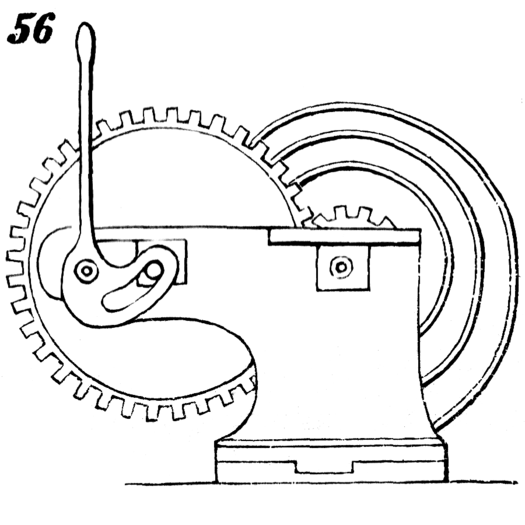
56. Used for throwing in and out of gear the speed-motion on lathes. On depressing the lever, the shaft of the large wheel is drawn backward by reason of the slot in which it slides being cut eccentrically to the center or fulcrum of the lever.