Movement No. 50 presents the first of two universal joint designs — one of the most mechanically important and widely used shaft coupling mechanisms in engineering history. A universal joint, also known as a Hooke’s joint or Cardan joint, solves a fundamental problem in mechanical power transmission: how to transmit continuous rotary motion between two shafts whose axes are not collinear — that is, two shafts that meet at an angle rather than being perfectly aligned. In a simple rigid coupling, any angular misalignment between two shafts would cause binding, vibration, and rapid mechanical failure. The universal joint elegantly solves this by introducing a cross-shaped intermediate element — the spider or cross piece — with four trunnions projecting at right angles. Two opposite trunnions pivot in a yoke fixed to the first shaft, while the other two trunnions pivot in a yoke fixed to the second shaft. This cruciform arrangement allows the joint to flex through a range of angles while continuously transmitting rotation from one shaft to the other. However, the classic single Hooke’s joint has a well-known kinematic limitation: even when the input shaft rotates at perfectly constant speed, the output shaft experiences a cyclic variation in angular velocity — speeding up and slowing down twice per revolution — whenever the shafts are at an angle. The magnitude of this velocity variation increases with the joint angle. This property makes the single universal joint unsuitable for applications requiring smooth, constant-velocity output at significant joint angles — a limitation addressed by using two joints in series, as in automotive driveshafts. Universal joints are found today in automobile driveshafts, steering columns, industrial machinery, and wherever angular shaft misalignment must be accommodated in a rotating drive system.
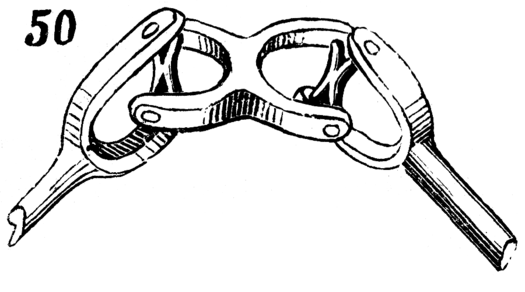
50 and 51. Two kinds of universal joints.