Movement No. 49 presents a remarkably clever mechanism that converts alternating oscillating circular motion of a horizontal shaft into continuous one-directional rotary motion of a vertical shaft — using a dual ratchet and bevel gear arrangement. Two bevel gears are mounted loosely on the horizontal shaft, each with a ratchet wheel rigidly attached. The ratchet teeth on the two wheels are oriented in opposite directions — one allows clockwise rotation and locks counterclockwise, the other does the reverse. The pawls are fixed to arms rigidly secured to the horizontal shaft itself. As the horizontal shaft oscillates back and forth, the pawls alternately engage each ratchet wheel in sequence. During one half of the oscillation, one pawl drives its bevel gear forward, transmitting rotation to the vertical output shaft — while the other pawl simply skips freely over its ratchet teeth. On the return stroke, the roles reverse: the second bevel gear is driven while the first freewheels. In this way, both the forward and return strokes of the oscillating input contribute useful driving force to the vertical shaft, which rotates continuously in one direction throughout the full cycle. This elegant mechanism demonstrates how a pair of opposing ratchets can rectify an oscillating input into smooth, continuous unidirectional output — a principle that appears in hand drills, winches, clockwork mechanisms, and early industrial machinery wherever reciprocating motion must be converted to continuous rotation.
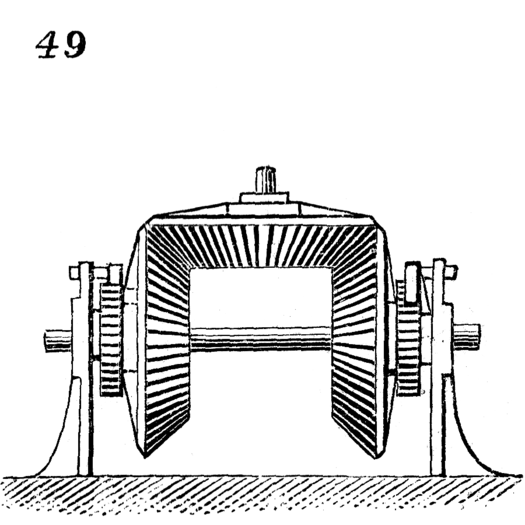
49. Alternate circular motion of the horizontal shaft produces a continuous rotary motion of the vertical shaft, by means of the ratchet-wheels secured to the bevel-gears, the ratchet-teeth of the two wheels being set opposite ways, and the pawls acting in opposite directions. The bevel-gears and ratchet-wheels are loose on the shaft, and the pawls attached to arms firmly secured on the shaft.