Movement No. 48 presents a positive jaw clutch-box integrated with a gear drive — a mechanism designed to selectively connect and disconnect a shaft from a continuously running gear transmission using a direct, positive engagement clutch rather than the friction-based approach of Movement No. 47. The system begins with a pinion at the top, which continuously receives rotary motion from an external source and meshes with a larger gear below it. This larger gear has one half of a jaw clutch rigidly attached to it — but critically, both the gear and its attached clutch half spin freely and loosely on the output shaft, meaning that even though the gear is always rotating, it transmits no motion to the shaft while the clutch is disengaged. The second half of the jaw clutch is mounted on the same shaft using a key or feather fixed in the shaft — exactly as in Movement No. 47 — so that this clutch half is rotationally locked to the shaft but can slide freely along it in the axial direction. When the operator wishes to engage the shaft, the lever is pushed to thrust this sliding clutch half axially into engagement with the gear-mounted clutch half. The interlocking jaws of the two clutch halves — positive tooth-like features that physically interlock — immediately lock the gear and the shaft together as a single rotating unit, transmitting full torque directly and positively to the shaft. Unlike the frictional clutch of No. 47, this jaw clutch provides a completely rigid, non-slip connection with no power loss through slipping. The trade-off is that jaw clutches must be engaged carefully — ideally when both halves are at or near the same speed — as engaging at speed mismatch produces a sudden shock load on the jaws and the connected machinery.
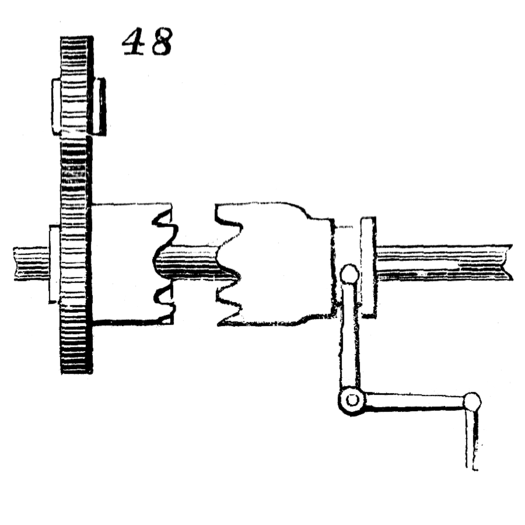
48. Clutch-box. The pinion at the top gives a continuous rotary motion to the gear below, to which is attached half the clutch, and both turn loosely on the shaft. When it is desired to give motion to the shaft, the other part of the clutch, which slides upon a key or feather fixed in the shaft, is thrust into gear by the lever.