Movement No. 46 presents one of the most elegant and historically celebrated mechanisms in all of horology — the fusee chain and spring-box, the prime mover of fine English pocket watches and precision timepieces. The central engineering challenge this mechanism solves is deceptively subtle: a coiled mainspring does not deliver a constant torque throughout its unwinding. When freshly wound, the spring is tightly coiled and exerts its maximum force. As it uncoils over hours of running, the force it delivers decreases progressively — and in a simple watch without compensation, this means the timepiece runs faster when newly wound and slower as the spring winds down, introducing unacceptable timekeeping errors. The fusee is an ingenious conical pulley, shaped like a truncated cone or a spiral-stepped spool, with a helical groove cut along its surface to guide a fine chain. The chain connects the fusee to the cylindrical spring-box containing the mainspring. The key to the fusee’s function lies in its varying diameter: when the watch is freshly wound and the mainspring exerts its greatest force, the chain sits on the small-diameter end of the fusee — the short lever arm reduces the torque transmitted to the gear train, compensating for the spring’s excess strength. As the spring uncoils and weakens over time, the chain progressively migrates to the larger-diameter portion of the fusee — the increasing lever arm compensates for the spring’s diminishing force, maintaining a nearly constant torque output to the watch’s gear train throughout the entire running period. The result is a remarkably constant driving force delivered to the escapement and balance wheel, enabling the watch to keep precise time from the moment it is wound until the spring is nearly exhausted.
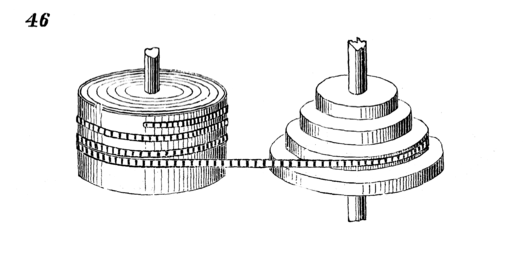
46. Fusee chain and spring-box, being the prime mover in some watches, particularly of English make. The fusee to the right is to compensate for the loss of force of the spring as it uncoils itself. The chain is on the small diameter of the fusee when the watch is wound up, as the spring has then the greatest force.