Movement No. 44 presents a powerful and ingenious gear configuration designed specifically to transmit very large forces while maintaining continuous tooth contact — the stepped or staggered spur gear. In an ordinary spur gear, all teeth are cut in a single straight plane, and each tooth pair engages and disengages abruptly, creating load impulses and limiting the smoothness and load capacity of the transmission. Movement No. 44 addresses this fundamental limitation through an elegant structural solution: each gear wheel in the system is not a single spur gear, but rather a composite assembly of two, three, or more identical spur gears stacked side by side on the same shaft — with each successive layer rotated by a small angular step relative to the previous one, so that the teeth are not aligned in a straight line but arranged in a staircase or stepped pattern around the gear face. This staggered tooth arrangement ensures that as the gears rotate, the teeth of each successive layer engage the mating gear at slightly different moments — creating a continuous, overlapping sequence of tooth engagements rather than simultaneous impacts. At any given instant, teeth from multiple layers are in contact simultaneously, distributing the total transmitted force across many contact points and dramatically increasing the effective load capacity and smoothness of the drive. Henry T. Brown specifically highlights two major historical applications: driving screw propellers on ships — where enormous torque must be transmitted smoothly — and driving the beds of large iron-planing machines with a matching stepped rack, where smooth, powerful, and precise linear motion of heavy workpieces is essential. The stepped gear is a direct mechanical precursor to the modern helical gear’s philosophy of progressive tooth engagement, but achieves this through discrete layered stages rather than a continuous helix.
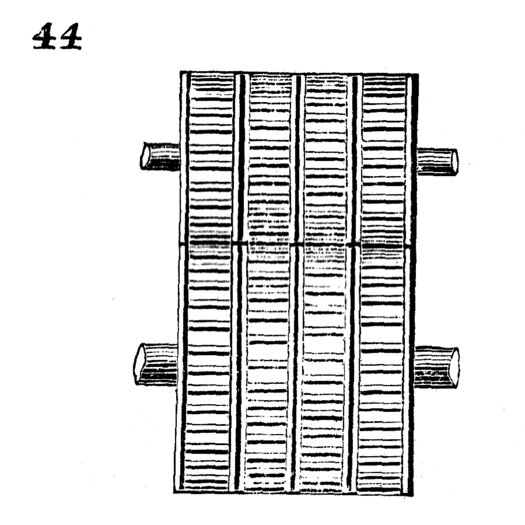
44. A kind of gearing used to transmit great force and give a continuous bearing to the teeth. Each wheel is composed of two, three, or more distinct spur-gears. The teeth, instead of being in line, are arranged in steps to give a continuous bearing. This system is sometimes used for driving screw propellers, and sometimes, with a rack of similar character, to drive the beds of large iron-planing machines.