Movement No. 38 presents a clever gear mechanism designed to produce a very specific and practically useful motion profile: an output rotation that is uniform (constant speed) during one portion of each revolution, and intentionally variable (changing speed) during another portion — all driven by a single constant-speed input. This type of motion profile is highly valuable in machinery where different phases of a machine’s cycle demand different speed characteristics. For example, a cutting tool may need to advance at a constant, controlled speed during the actual cutting stroke for quality and precision, then return quickly at a varying speed during the non-cutting return stroke to maximize productivity. The mechanism achieves this dual-phase motion profile through careful geometric design of the gear or cam profiles involved. During the uniform-speed phase, the effective gear ratio remains constant — meaning the driving and driven elements maintain a fixed relationship, producing steady output velocity. During the variable-speed phase, the effective gear ratio changes continuously, causing the output to accelerate or decelerate smoothly. This is typically achieved by using a combination of circular gear sections (for the uniform phase) and non-circular or eccentric gear sections (for the variable phase) on the same wheel, so that a single revolution of the driver produces both speed regimes in sequence. The result is a single mechanism capable of delivering two fundamentally different motion characteristics within each complete cycle — a hallmark of elegant and efficient mechanical design that was widely sought after in 19th-century industrial machinery.
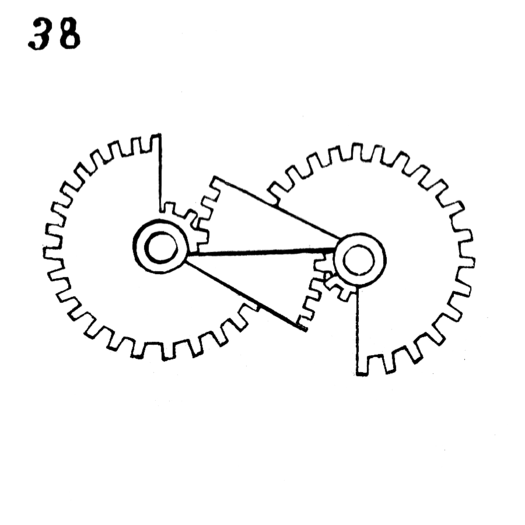
38. A means of converting rotary motion, by which the speed is made uniform during a part, and varied during another part, of the revolution.