Friction wheels are one of the simplest forms of power transmission mechanisms. Unlike toothed gears, friction wheels transfer rotational motion through direct surface contact and the frictional force between two wheels pressed against each other. To maximize grip and minimize slippage, the contact surfaces are made intentionally rough — traditionally faced with leather or, more effectively, with vulcanized rubber. The direction of rotation of the driven wheel is opposite to that of the driver wheel when they contact externally, and the speed ratio is determined by the ratio of their diameters. While friction wheels cannot transmit heavy loads without slipping, they offer the advantage of smooth, quiet operation and act as a natural overload protection, since the wheels will simply slip rather than break under excessive torque. This mechanism was widely used in light machinery, instruments, and early industrial applications where quiet running and simplicity were priorities.
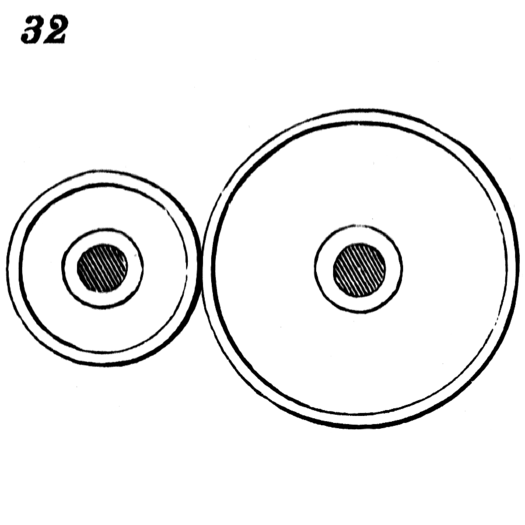
32. Friction-wheels. The surfaces of these wheels are made rough, so as to bite as much as possible; one is sometimes faced with leather, or, better, with vulcanized india-rubber.