Movement No. 27 presents a fascinating and inventive mechanism known as “multiple gearing” — described in Henry T. Brown’s original text as a recent invention at the time of publication. The mechanism consists of two wheels of different sizes: a smaller triangular driving wheel equipped with friction rollers mounted on its vertices or edges, and a larger driven wheel featuring a series of radial grooves cut into its face or rim. As the triangular wheel rotates, its friction rollers engage with the radial grooves of the larger wheel in sequence, pushing against them to transmit rotational motion. Unlike conventional gear teeth that interlock rigidly, the rollers roll smoothly into and out of the grooves, reducing wear and allowing for quieter, smoother power transmission. The geometry of the triangular driver means that three rollers engage per full revolution, and the speed ratio is determined by the number of grooves on the driven wheel relative to the number of engagement points on the driver. This elegant mechanism bridges the principles of friction drives and positive engagement gearing, and stands as an early example of roller gear technology that would later evolve into modern sprocket and roller chain systems.
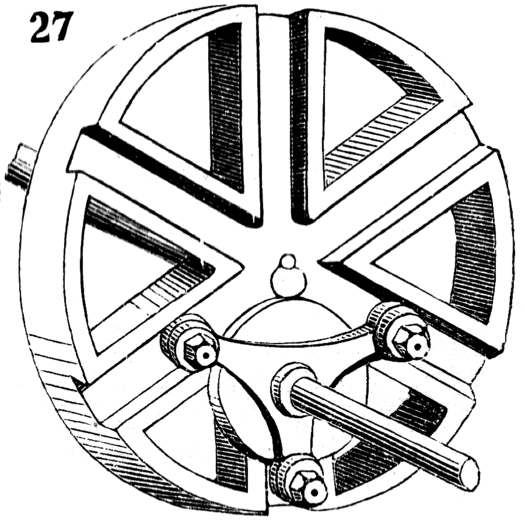
27. "Multiple gearing"-a recent invention. The smaller triangular wheel drives the larger one by the movement of its attached friction-rollers in the radial grooves.