Movement No. 25 presents one of the most fundamental and widely used mechanisms in mechanical engineering — the bevel gear. Bevel gears are conical gears designed to transmit rotational motion between two shafts that intersect at an angle, most commonly at 90 degrees. Unlike spur gears which operate on parallel shafts, bevel gears have teeth cut along the surface of a cone, allowing power to be redirected efficiently around a corner. The pitch surfaces of the two mating bevel gears are cones that share a common apex at the point where the two shaft axes intersect. A special and particularly common case of bevel gears is the miter gear — when both gears in the pair are of equal diameter and equal tooth count, they are called miter gears. Miter gears always operate at a 1:1 gear ratio, meaning they transmit motion at the same speed between two perpendicular shafts without any speed change. Bevel gears of unequal diameters, by contrast, produce a change in rotational speed and torque proportional to their size difference. Bevel gears are found in countless applications including automotive differentials, hand drills, printing presses, locomotives, and marine propulsion systems — wherever a change in the direction of rotation is required.
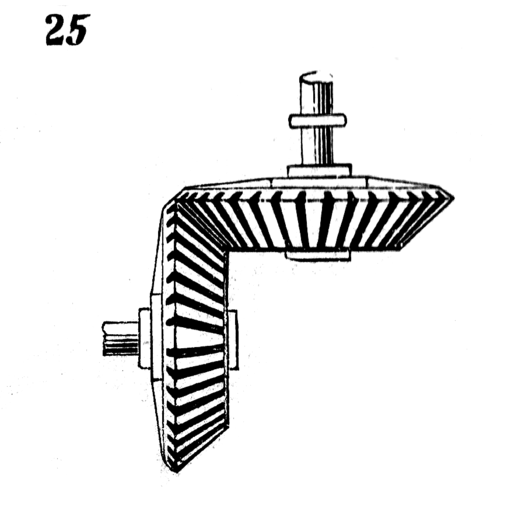
25. Bevel-gears. Those of equal diameters are termed "miter-gears."