Movement No. 17 presents one of two configurations of the mechanism historically known as the “Spanish Burton” — a specialized compound pulley arrangement that has been used for centuries in maritime rigging and heavy-lift operations. The Spanish Burton is a clever compound pulley system that achieves a mechanical advantage of 3:1 or greater by combining fixed and movable pulleys in a specific rope routing arrangement. Unlike a simple block-and-tackle where a single rope continuously threads through multiple sheaves, the Spanish Burton achieves its mechanical advantage through a compound arrangement: one simple pulley system is effectively applied to another. A key and distinctive characteristic of the Spanish Burton is that it allows the operator to pull downward — in the same direction as gravity — to lift the load upward, which is particularly advantageous in nautical environments where the crew can use their body weight to haul on a downward-running rope rather than pulling upward against the load. This also means the system can be operated from a lower, more stable position. The rope routing creates a compound multiplication of force that produces a mechanical advantage of 3:1 with the arrangement shown in No. 17, meaning a force of 1 unit lifts a load of 3 units. The Spanish Burton was a staple of traditional sailing ship rigging — used to haul sails, spars, and heavy cargo — and its principle of compounding simple pulley systems to achieve higher mechanical advantage is directly reflected in modern compound rescue haul systems used by firefighters, mountaineers, and rescue teams today.
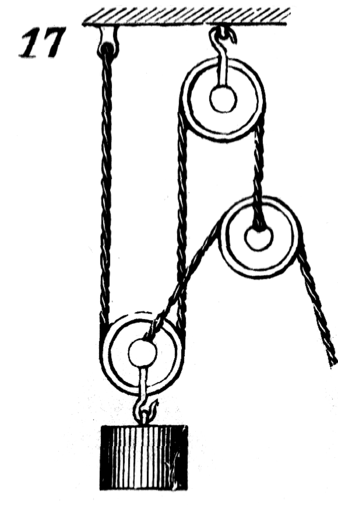
16 and 17. Are what are known as Spanish bartons.