Movement No. 16 presents the simpler of two configurations of the Spanish Burton — a specialized compound pulley system with a long and distinguished history in maritime rigging and heavy-load lifting. The Spanish Burton is fundamentally a compound tackle: it achieves its mechanical advantage not by threading a single rope through many sheaves as in a standard block-and-tackle, but by applying one simple pulley system on top of another in a compound arrangement. In the simpler configuration shown in Movement No. 16, the system typically consists of a small number of pulleys — including at least one movable pulley attached to the load — arranged so that the operator’s effort rope runs downward. This downward pull is one of the most celebrated and practical advantages of the Spanish Burton: the operator can use their own body weight to haul the load upward, making the system significantly more ergonomic and powerful than arrangements requiring an upward pull. The resulting mechanical advantage in this basic configuration is typically 3:1 — meaning three units of load can be lifted by applying just one unit of force — while the effort rope must travel three times the distance of the load’s rise. The Spanish Burton was a cornerstone of traditional sailing ship rigging, used to hoist cargo, sails, and heavy spars aloft, and the principles it embodies continue to be applied in modern rescue systems, construction equipment, and arborist rigging.
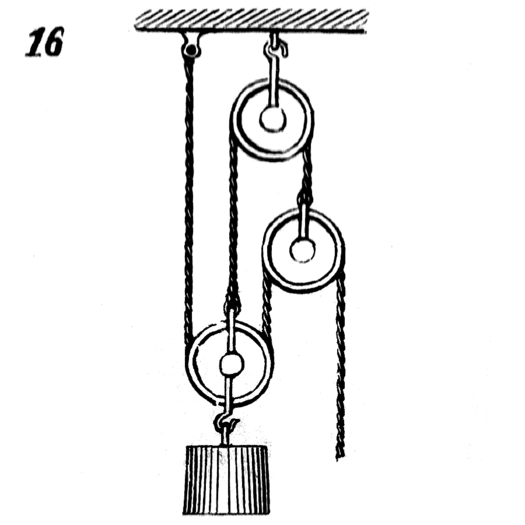
16 and 17. Are what are known as Spanish bartons.