Movement No. 12 presents the most fundamental of all pulley mechanisms — the simple fixed pulley used for lifting weights. In this arrangement, a single pulley is mounted in a fixed position overhead, and a rope passes over its grooved sheave. One end of the rope is attached to the load, and the operator pulls downward on the other end. The defining physical principle of this mechanism, stated precisely by Henry T. Brown, is that the power applied must equal the weight of the load to achieve equilibrium — meaning that the simple fixed pulley provides no mechanical advantage whatsoever. A force of 10 units is required to lift a load of 10 units. So why use a pulley at all? The answer lies in the critical benefit that the simple fixed pulley does provide: it changes the direction of the applied force. Rather than requiring the operator to pull upward against the load — which is both awkward and physically demanding — the fixed pulley redirects the rope so the operator can pull downward, using gravity and body weight to assist the effort. This makes the task far more ergonomic and practical in real-world applications. The simple fixed pulley is also the fundamental building block from which all more complex pulley systems — including the block and tackle, Spanish Burton, and White’s Pulleys seen in subsequent movements — are derived and understood. Its conceptual clarity makes it the ideal starting point for teaching the principles of pulleys, force, and mechanical advantage in physics and engineering education.
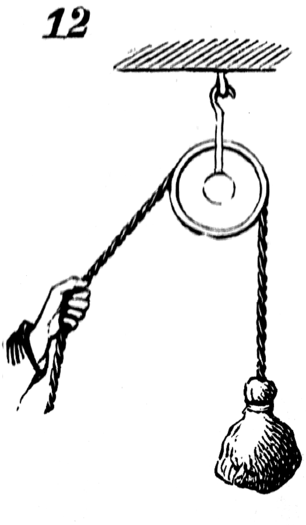
12. Simple pulley used for lifting weights. In this the power must be equal to the weight to obtain equilibrium.