Movement No. 9 presents one of the most practically significant variable speed transmission mechanisms in the history of mechanical engineering — the Cone Pulley system. Two opposing conical pulleys are mounted on parallel shafts, with their tapers arranged in mirror image: where one cone is wide, the other is narrow, and vice versa. A flat drive belt connects the two cones and can be shifted laterally along their length to any of several discrete positions. At each position, the belt contacts the two cones at different effective diameters — a large diameter on one and a correspondingly small diameter on the other — producing a specific speed ratio between the input and output shafts. By sliding the belt from one end of the cone pair toward the other, the operator can progressively increase or decrease the output speed in a series of steps, achieving what Henry T. Brown describes as a “gradually increased or diminished speed.” The speed ratio at any belt position is directly proportional to the ratio of the two effective contact diameters: if the driver cone contacts the belt at twice the diameter of the driven cone, the output shaft turns at twice the input speed, and vice versa. Henry T. Brown specifically highlights its use in cotton machinery — a reference to the textile mills of the Industrial Revolution, where precise and adjustable speed control was essential for spinning and weaving operations. The cone pulley remains a direct mechanical ancestor of the modern continuously variable transmission (CVT), and its stepped speed-change principle is still found today in drill presses, metal lathes, and milling machines worldwide.
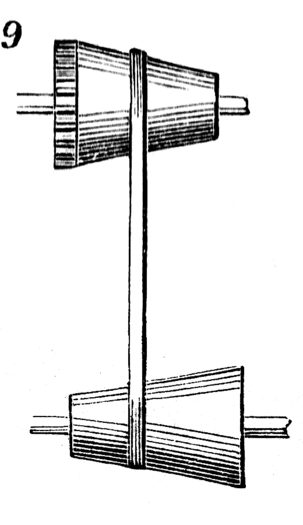
9. Cone-pulleys for the same purpose as 8. This motion is used in cotton machinery, and in all machines which are required to run with a gradually increased or diminished speed.