Movement No. 5 builds directly upon Movement No. 1 — the basic flat belt drive between two pulleys — by introducing one critically important addition: a movable tightening pulley, B, which acts as a belt clutch. In the basic configuration, a flat drive belt connects two larger pulleys on parallel shafts. However, the belt is intentionally made slightly slack — loose enough that when left untensioned, it slips freely over both pulleys without transmitting any rotational motion. This slack condition represents the disengaged or “neutral” state of the mechanism. The genius of the system lies in the tightening pulley B — a small idler pulley mounted on a movable arm or pivot. When pulley B is pressed inward against the slack belt, it takes up the excess slack, increasing the belt’s tension against both large pulleys and restoring sufficient friction for the belt to positively grip the driver pulley and transmit motion to the driven pulley. The mechanism is thereby engaged and power flows through the system. When pulley B is released and withdrawn, the belt returns to its slack condition and power transmission ceases immediately. This arrangement is one of the simplest and most reliable forms of belt clutch ever devised — it requires no complex interlocking components, produces no shock loads on engagement, and can be operated with minimal effort by pressing or releasing a lever connected to the tightening pulley arm. Henry T. Brown’s description captures this elegantly: the belt transmits motion when the pulley is pressed, and does not transmit when it is not. This fundamental mechanism is the direct precursor to the modern tensioner-clutch systems found in agricultural machinery, go-kart engines, garden equipment, and early industrial machine tools.
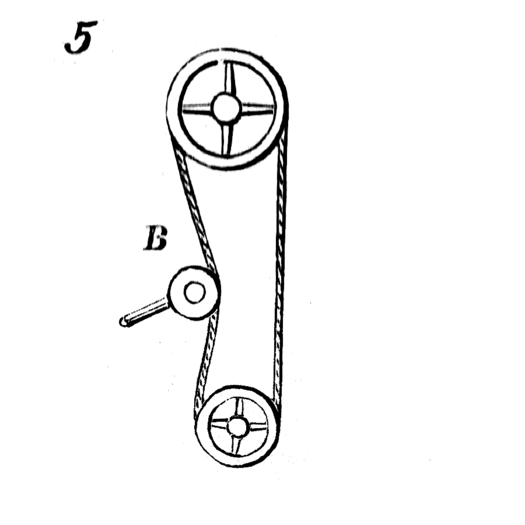
5. Resembles 1, with the addition of a movable tightening pulley, B. When this pulley is pressed against the band to take up the slack, the belt transmits motion from one of the larger pulleys to the other; but when it is not, the belt is so slack as not to transmit motion.