Movement No. 2 builds directly upon Movement No. 1 — the simple open belt drive — by introducing the crossed belt configuration and, in doing so, unlocking one of the most practically powerful features in classical belt transmission: the ability to reverse the direction of the driven shaft without stopping or reversing the driving motor. In its simplest form, replacing the open belt of No. 1 with a crossed belt — where the belt forms an X shape between the two pulleys — reverses the direction of rotation of the driven pulley relative to the driver. With an open belt, both pulleys rotate in the same direction; with a crossed belt, they rotate in opposite directions. But Movement No. 2 goes further, describing an elegant three-pulley reversing mechanism: three pulleys are mounted side by side on the driven shaft — the center pulley is fixed (keyed) to the shaft, while the two outer pulleys are loose (they spin freely on the shaft without driving it). Two belts are used simultaneously — one open belt and one crossed belt — each connecting the driver to one of the three driven-side pulleys. At any moment, one belt rides on the fixed center pulley (driving the shaft), while the other rides on a loose outer pulley (spinning freely, doing nothing). By shifting both belts simultaneously — moving the active belt from the center fast pulley to a loose pulley, while moving the idle belt from a loose pulley to the center fast pulley — the shaft direction is instantly reversed, all while the driving motor continues running at full speed without interruption. This elegant and reliable direction-reversing mechanism was widely used in 19th-century machine tools, lathes, milling machines, and early industrial equipment, and represents a foundational principle of mechanical power control that predates electrical motor reversing by many decades.
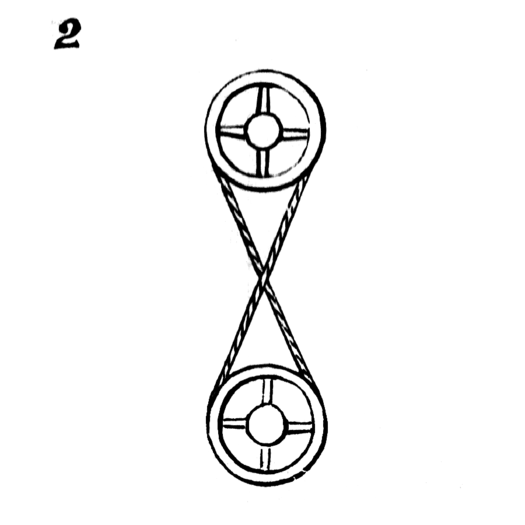
2. Differs from 1 in the substitution of a crossed belt for the open one. In this case the direction of rotation of the pulleys is reversed. By arranging three pulleys, side by side, upon the shaft to be driven, the middle one fast and the other two loose upon it, and using both an open and a crossed belt, the direction of the said shaft is enabled to be reversed without stopping or reversing the driver. One belt will always run on the fast pulley, and the other on one of the loose pulleys. The shaft will be driven in one direction or the other, according as the open or crossed belt is on the fast pulley.