Movement No. 1 is the very first entry in Henry T. Brown’s landmark 1868 reference work — and fittingly, it presents the most fundamental and universally important mechanism in the entire field of mechanical power transmission: the simple open belt and pulley drive. Two pulleys of equal or different diameters are mounted on separate parallel shafts, connected by a continuous flat belt that runs in a straight, uncrossed path between them — forming what is known as an open belt configuration. As the driver pulley rotates, friction between the belt and pulley surfaces causes the belt to move, which in turn drives the second pulley by the same frictional engagement on the other end. The defining characteristic of the open belt configuration, stated precisely by Henry T. Brown, is that both pulleys rotate in the same direction — if the driver turns clockwise, the driven pulley also turns clockwise. The speed ratio between the two pulleys is determined purely by the inverse ratio of their diameters: a driven pulley with half the diameter of the driver will rotate at twice the speed, while one with twice the diameter will rotate at half the speed. The torque ratio follows the inverse relationship. Power is transmitted entirely through friction between the belt and pulley surfaces — no teeth, no rigid connections, no direct contact between the shafts. This frictional nature provides a natural overload protection: under excessive load, the belt slips rather than breaking the machinery. The open belt and pulley is the ancestor of every belt-driven machine ever built — from the great line-shaft mills of the Industrial Revolution to modern serpentine belt systems in automobile engines, V-belt drives in HVAC equipment, and conveyor systems worldwide. It is the logical and historical starting point for the entire 507 Mechanical Movements collection.
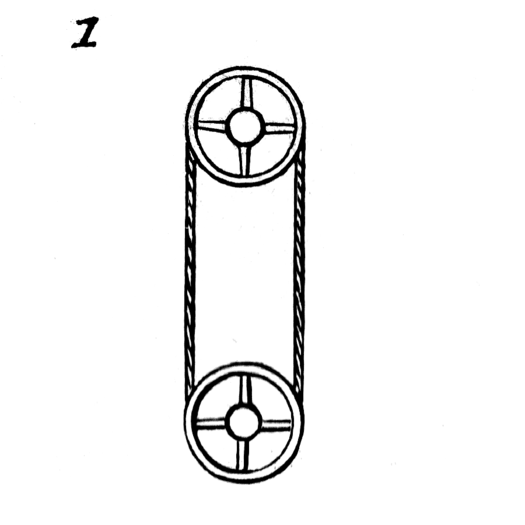
1. Illustrates the transmission of power by simple pulleys and an open belt. In this case both of the pulleys rotate in the same direction.