All Categories

1 category

#016 Spanish Barton Pulley System – 507 Mechanical Movements 3D Animation

#016 Spanish Barton Pulley System – 507 Mechanical Movements 3D Animation

Friday, Jan 30, 2026

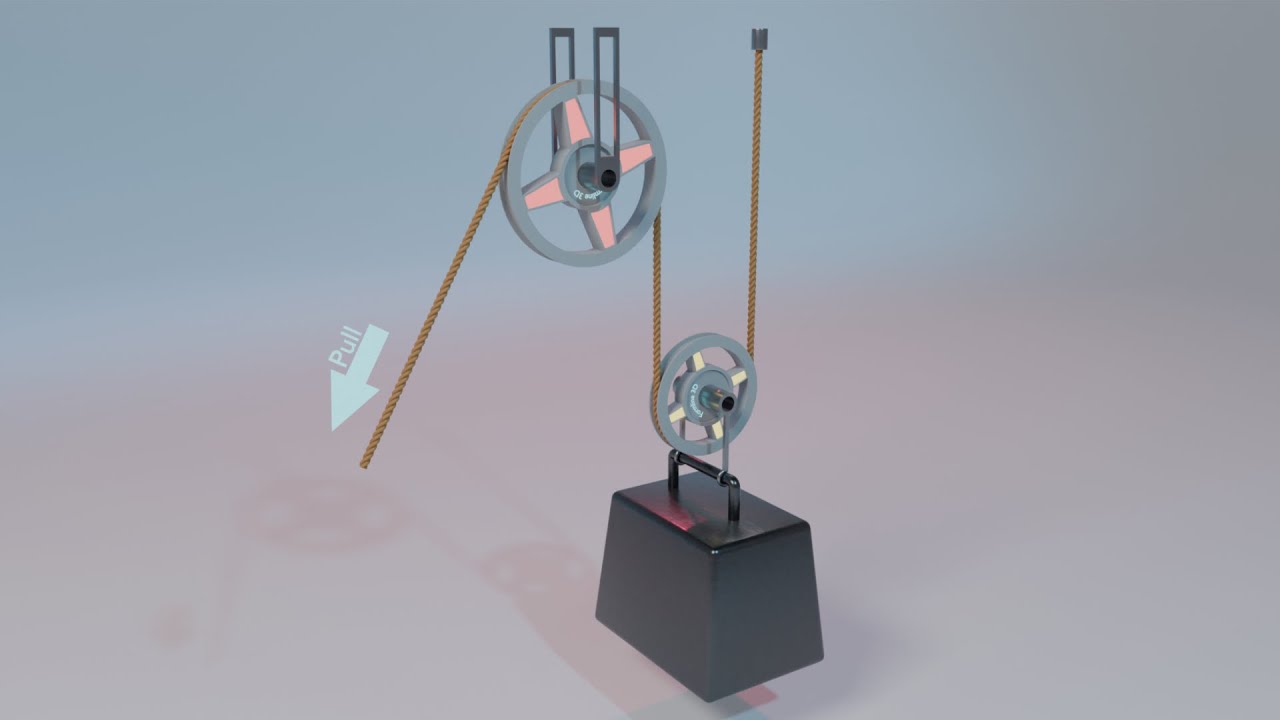
Movement No. 16 presents the simpler of two configurations of the Spanish Burton — a specialized compound pulley system with a long and distinguished history in maritime rigging and heavy-load lifting. The Spanish Burton is fundamentally a compound tackle: it achieves its mechanical advantage not by threading a single rope through many sheaves as in a standard block-and-tackle, but by applying one simple pulley system on top of another in a compound arrangement. In the simpler configuration shown in Movement No. 16, the system typically consists of a small number of pulleys — including at least one movable pulley attached to the load — arranged so that the operator’s effort rope runs downward. This downward pull is one of the most celebrated and practical advantages of the Spanish Burton: the operator can use their own body weight to haul the load upward, making the system significantly more ergonomic and powerful than arrangements requiring an upward pull. The resulting mechanical advantage in this basic configuration is typically 3:1 — meaning three units of load can be lifted by applying just one unit of force — while the effort rope must travel three times the distance of the load’s rise. The Spanish Burton was a cornerstone of traditional sailing ship rigging, used to hoist cargo, sails, and heavy spars aloft, and the principles it embodies continue to be applied in modern rescue systems, construction equipment, and arborist rigging.

@
2 minute read
#015 White’s Pulleys – 507 Mechanical Movements 3D Animation

#015 White’s Pulleys – 507 Mechanical Movements 3D Animation

Thursday, Jan 29, 2026

Movement No. 15 introduces one of the most ingeniously designed pulley systems in classical mechanics — White’s Pulleys, an elegant invention that achieves a high mechanical advantage through a uniquely different principle compared to conventional block-and-tackle systems. Rather than using a series of simple sheaves of equal diameter threaded by a single rope, White’s Pulleys employ two blocks, each containing multiple concentric grooves of carefully graduated diameters. The upper fixed block has grooves in the proportions of 1, 3, and 5 units in diameter, while the lower movable block has grooves of 2, 4, and 6 units. A single continuous rope is wound progressively across these grooves in sequence — from the smallest groove on one block to the next-sized groove on the other, spiraling its way across all six grooves. The critical engineering insight behind this design is that because each groove has a different diameter, the rope travels a different distance at each groove as the blocks rotate. This differential in rope speed across the grooves means that the rope effectively self-regulates its own tension, preventing the binding and jamming that can occur in conventional multi-sheave systems where all sheaves are the same diameter. The result is a smooth, efficient system with an overall mechanical advantage of 7:1 — meaning a force of just 1 unit can lift a load of 7 units. White’s Pulleys represent a brilliant intersection of geometry and mechanical engineering, and stand as an early example of how matching component geometry to motion kinematics can dramatically improve system performance.

@
2 minute read
#014 Blocks and Tackle – 507 Mechanical Movements 3D Animation

#014 Blocks and Tackle – 507 Mechanical Movements 3D Animation

Wednesday, Jan 28, 2026

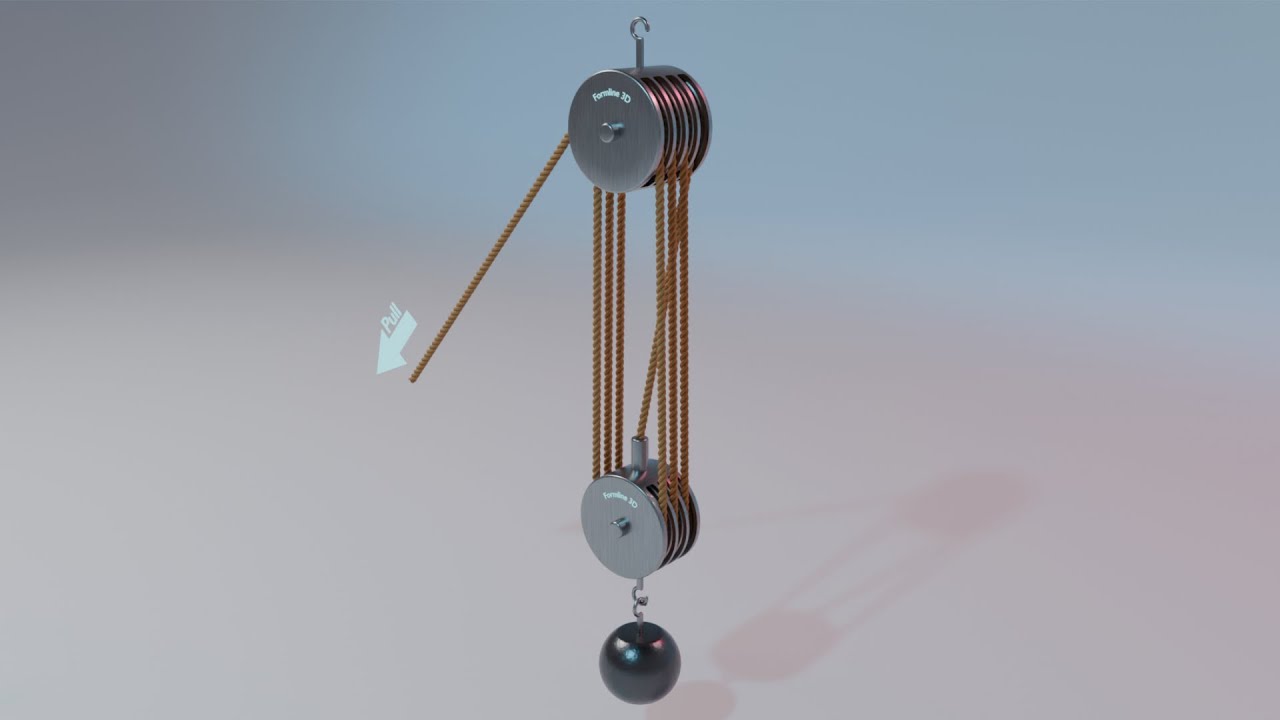
Movement No. 14 presents the classic Block and Tackle — one of the oldest, most practical, and most widely used compound pulley systems in human history. A block and tackle consists of two sets of pulleys: an upper fixed block, anchored to a stationary overhead support, and a lower movable block, attached directly to the load being lifted. A single continuous rope threads back and forth between the sheaves of both blocks in sequence, with one end anchored to the fixed block and the free end available for the operator to apply effort. The genius of this arrangement lies in its elegant simplicity and the straightforward rule for calculating mechanical advantage provided by Henry T. Brown: divide the weight of the load by double the number of pulleys in the lower movable block. This means that if the lower block contains 3 pulleys, the required effort force is the load divided by 6 — a mechanical advantage of 6:1. Every additional pulley added to the lower block adds two more rope segments supporting the load, further dividing the required effort force. The trade-off remains constant: the effort rope must be pulled through a distance proportional to the mechanical advantage gained. With its ability to lift enormous loads with modest applied force, the block and tackle has been indispensable across centuries of human endeavor — from ancient Egyptian construction of pyramids and Greek shipbuilding, to medieval siege engines, sailing ship rigging, and modern industrial cranes and rescue systems.

@
2 minute read
#013 Movable Lower Pulley – 507 Mechanical Movements 3D Animation

#013 Movable Lower Pulley – 507 Mechanical Movements 3D Animation

Tuesday, Jan 27, 2026

Movement No. 13 presents one of the most fundamental and elegant demonstrations of mechanical advantage in classical mechanics — the single movable pulley with one fixed rope end. The arrangement is deceptively simple: an upper fixed pulley is mounted to a stationary overhead support, and a lower movable pulley is attached directly to the load. A single rope passes over the upper fixed pulley and under the movable lower pulley — one end of the rope is anchored firmly to a fixed point, while the operator pulls upward on the free end. The key physical insight stated by Henry T. Brown is precise and illuminating: because one end of the rope is fixed, the free end must be pulled at twice the speed of the rising load. This velocity relationship is the direct consequence of the mechanical advantage: the load is supported by two rope segments simultaneously — the fixed side and the hauling side — each bearing half the load’s weight. Therefore, the operator need only apply half the force of the load to lift it, achieving a 2:1 mechanical advantage. The price paid for this force reduction is the distance traveled: for every unit the load rises, the rope must be pulled through two units of length. This movement illustrates the universal principle of simple machines — force and distance are always traded against each other — and serves as a foundational building block for understanding the more complex compound pulley systems that follow in Movements 14 through 22. The single movable pulley remains one of the most universally applied mechanical principles in existence, found in everything from flagpoles and window blinds to rock climbing gear and construction cranes.

@
2 minute read
#012 Simple Lifting Pulley – 507 Mechanical Movements 3D Animation

#012 Simple Lifting Pulley – 507 Mechanical Movements 3D Animation

Monday, Jan 26, 2026

Movement No. 12 presents the most fundamental of all pulley mechanisms — the simple fixed pulley used for lifting weights. In this arrangement, a single pulley is mounted in a fixed position overhead, and a rope passes over its grooved sheave. One end of the rope is attached to the load, and the operator pulls downward on the other end. The defining physical principle of this mechanism, stated precisely by Henry T. Brown, is that the power applied must equal the weight of the load to achieve equilibrium — meaning that the simple fixed pulley provides no mechanical advantage whatsoever. A force of 10 units is required to lift a load of 10 units. So why use a pulley at all? The answer lies in the critical benefit that the simple fixed pulley does provide: it changes the direction of the applied force. Rather than requiring the operator to pull upward against the load — which is both awkward and physically demanding — the fixed pulley redirects the rope so the operator can pull downward, using gravity and body weight to assist the effort. This makes the task far more ergonomic and practical in real-world applications. The simple fixed pulley is also the fundamental building block from which all more complex pulley systems — including the block and tackle, Spanish Burton, and White’s Pulleys seen in subsequent movements — are derived and understood. Its conceptual clarity makes it the ideal starting point for teaching the principles of pulleys, force, and mechanical advantage in physics and engineering education.

@
2 minute read
#011 Right-Angle Belt Drive – 507 Mechanical Movements 3D Animation

#011 Right-Angle Belt Drive – 507 Mechanical Movements 3D Animation

Sunday, Jan 25, 2026

Movement No. 11 presents an elegant and compact solution to the classic engineering challenge of transmitting rotational power between two shafts oriented at right angles to one another — and does so without the use of any guide pulleys. This movement is directly related to Movement No. 3, which achieves the same right-angle belt transmission but requires guide pulleys to keep the belt properly aligned and tensioned as it transitions between the two perpendicular shaft planes. Movement No. 11 eliminates this requirement entirely by exploiting the natural geometry of the belt itself: the two pulleys are positioned and oriented at precise angles relative to each other so that a flat belt can travel from one pulley to the other in a smooth, self-guided quarter-turn twist — transitioning the plane of the belt by 90 degrees without any intermediate guiding or tensioning devices. This works because the belt naturally tends to track toward the highest point of any crowned or angled pulley surface it contacts, and when the pulleys are carefully positioned so that the departing side of each pulley aims directly at the center plane of the receiving pulley, the belt maintains stable tracking through the quarter-turn transition entirely on its own. The result is a mechanically simpler, more compact, and lower-maintenance drive system compared to guide-pulley arrangements, making it particularly attractive in applications where space is limited or simplicity of construction is a priority. This principle continues to be applied in modern flat-belt and serpentine-belt power transmission systems.

@
2 minute read
#010 Modified Variable Speed Pulley Drive – 507 Mechanical Movements 3D Animation

#010 Modified Variable Speed Pulley Drive – 507 Mechanical Movements 3D Animation

Saturday, Jan 24, 2026

Movement No. 10 is a direct modification and refinement of Movement No. 9 — the classic Variable Speed Cone Pulley system — but with a critically important difference: the pulleys are no longer simple straight-sided cones, but instead feature curved, nonlinear profiles. In Movement No. 9, two opposing conical pulleys with linear (straight) tapers are connected by a belt that can be shifted along their length to vary the output speed. While elegant in concept, straight-sided cone pulleys have a geometric limitation: as the belt shifts to different positions along the cone, the rate of speed change is not uniform — and importantly, the belt tends to twist and run unevenly because the linear cone geometry does not perfectly satisfy the geometric condition that the belt must always travel in a single plane. Movement No. 10 addresses this fundamental limitation by replacing the straight cone profiles with carefully calculated curved profiles — typically following a mathematical curve such that at every belt position along the pulley pair, the sum of the effective radii of the two pulleys remains exactly constant. This constant-sum condition ensures that the belt always runs at the same total length, maintaining consistent tension regardless of the belt’s position, and that the belt lies in a true plane at all times, eliminating the twisting tendency. The result is a smoother, more mechanically correct, and more reliable continuously variable transmission than the straight-cone version of No. 9. This principle of nonlinear pulley profiling directly informs the design of modern CVT (continuously variable transmission) systems used in automobiles, motorcycles, and industrial machinery.

@
2 minute read
#009 Variable Speed Cone Pulleys – 507 Mechanical Movements 3D Animation

#009 Variable Speed Cone Pulleys – 507 Mechanical Movements 3D Animation

Thursday, Jan 22, 2026

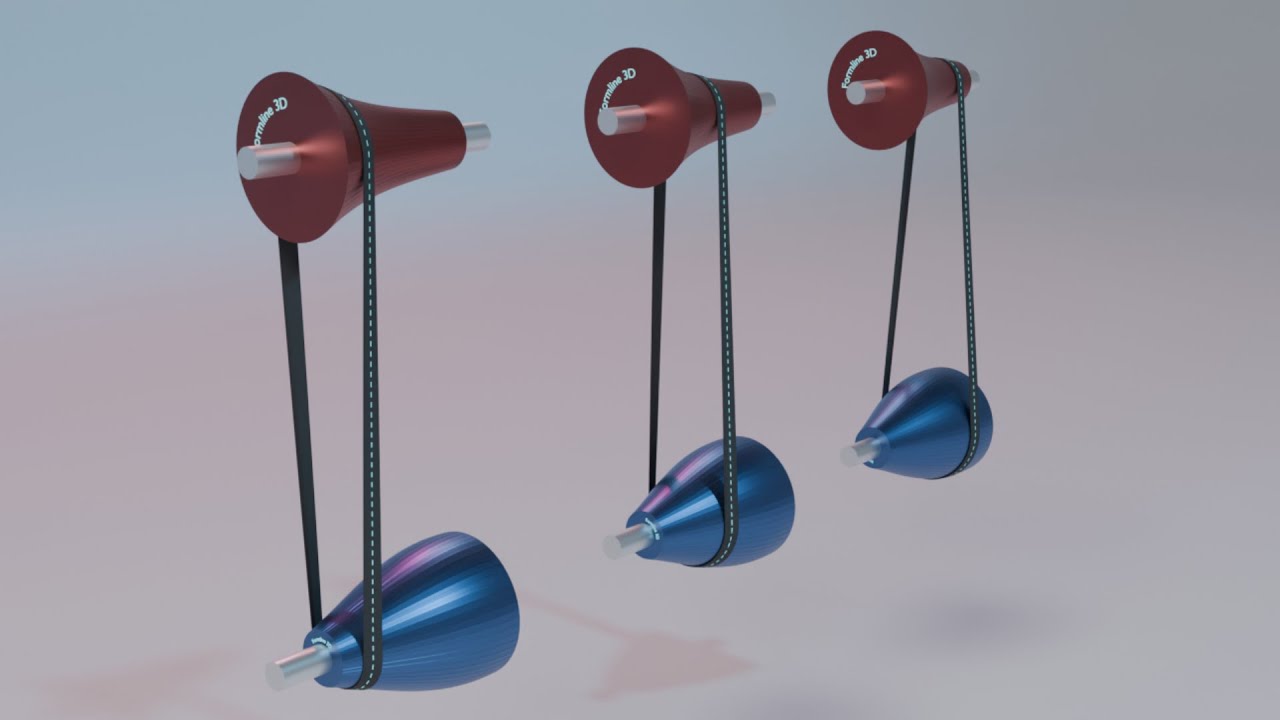
Movement No. 9 presents one of the most practically significant variable speed transmission mechanisms in the history of mechanical engineering — the Cone Pulley system. Two opposing conical pulleys are mounted on parallel shafts, with their tapers arranged in mirror image: where one cone is wide, the other is narrow, and vice versa. A flat drive belt connects the two cones and can be shifted laterally along their length to any of several discrete positions. At each position, the belt contacts the two cones at different effective diameters — a large diameter on one and a correspondingly small diameter on the other — producing a specific speed ratio between the input and output shafts. By sliding the belt from one end of the cone pair toward the other, the operator can progressively increase or decrease the output speed in a series of steps, achieving what Henry T. Brown describes as a “gradually increased or diminished speed.” The speed ratio at any belt position is directly proportional to the ratio of the two effective contact diameters: if the driver cone contacts the belt at twice the diameter of the driven cone, the output shaft turns at twice the input speed, and vice versa. Henry T. Brown specifically highlights its use in cotton machinery — a reference to the textile mills of the Industrial Revolution, where precise and adjustable speed control was essential for spinning and weaving operations. The cone pulley remains a direct mechanical ancestor of the modern continuously variable transmission (CVT), and its stepped speed-change principle is still found today in drill presses, metal lathes, and milling machines worldwide.

@
2 minute read
#008 Stepped Pulley Speed Control – 507 Mechanical Movements 3D Animation

#008 Stepped Pulley Speed Control – 507 Mechanical Movements 3D Animation

Wednesday, Jan 21, 2026

Movement No. 8 presents the Variable Speed Stepped Pulley — one of the most widely used and practically important speed-control mechanisms in the history of machine tool design. The stepped pulley system consists of two matched pulley sets, each comprising multiple pulley stages of different diameters arranged in a staircase-like profile — hence the name “stepped pulleys.” The two sets are mounted on parallel shafts (typically the drive shaft and the machine spindle shaft), with their steps arranged in opposing order: where the driver pulley set has its largest step, the driven pulley set has its smallest, and vice versa. A single flat belt connects the two sets and can be manually shifted from one step to another, engaging a different pair of opposing diameters at each position. Each belt position produces a specific, fixed speed ratio determined by the diameter ratio of the engaged steps. With three steps on each pulley set, for example, three distinct output speeds are available — giving the machine operator the ability to select the most appropriate spindle speed for the material and cutting tool in use. Henry T. Brown specifically cites its application in lathes and other mechanical tools — a testament to the mechanism’s central importance during the Industrial Revolution, when precise speed selection was critical for turning wood, brass, iron, and steel to different finishes. Unlike the cone pulley of Movement No. 9, which allows the belt to be placed at any position along a continuous taper, the stepped pulley provides discrete, repeatable speed selections, making it simpler and more reliable for workshop environments. Stepped pulleys can still be found today in drill presses, bench lathes, and wood-turning equipment worldwide.

@
2 minute read
#007 Pulley Transmission – 507 Mechanical Movements 3D Animation

#007 Pulley Transmission – 507 Mechanical Movements 3D Animation

Tuesday, Jan 20, 2026

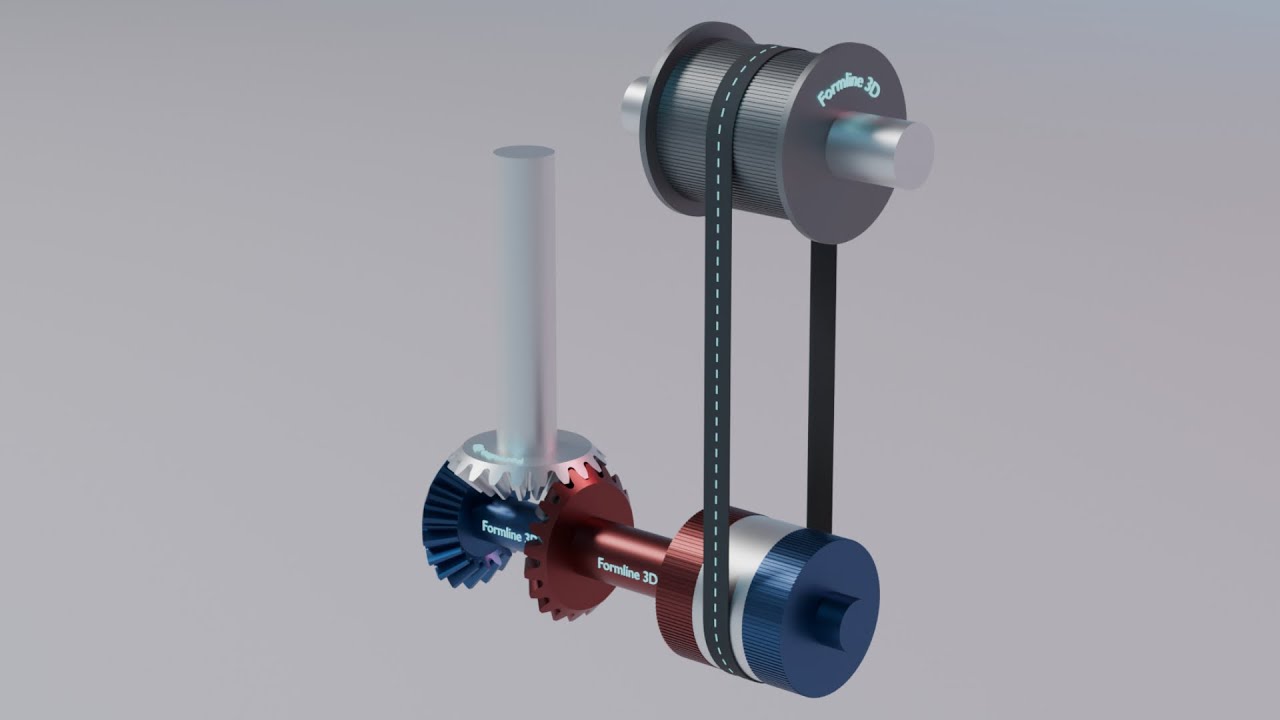
Movement No. 7 presents a brilliantly elegant mechanism for engaging, disengaging, and reversing an output shaft using nothing more than a shifting belt and a carefully arranged system of concentric shafts and bevel gears — with no friction clutch or complex reversing gearbox required. The mechanism operates through three distinct states controlled entirely by the lateral position of a single drive belt. At the heart of the system are two coaxial shafts: an outer hollow shaft, b, and an inner solid shaft, a, which runs concentrically inside it. Three pulleys sit side by side on the drive shaft — a left pulley fixed to the hollow shaft b (carrying bevel gear B), a center loose pulley that spins freely and transmits no motion, and a right pulley fixed to inner shaft a (connected to bevel gear A). When the belt rides on the center loose pulley, neither shaft turns — the system is disengaged and the output vertical shaft is stationary. When the belt is shifted left onto the pulley fixed to hollow shaft b, bevel gear B drives the upright output shaft in one direction. When the belt is shifted right onto the pulley fixed to inner shaft a, bevel gear A transmits drive to the upright shaft — but because shaft a and shaft b are concentric and their bevel gears mesh with the output shaft from different geometric arrangements, the direction of rotation of the output shaft is reversed. This gives the operator full three-state control — forward, neutral, and reverse — using only a belt shift lever. This mechanism was widely used in 19th-century machine tools, milling machines, and industrial equipment as a simple and reliable means of shaft direction control without stopping the prime mover.

@
2 minute read

© 2026 Formline 3D Mechanisms

Powered by Formline 3D

Formline 3D

Formline 3D is a 3D animation channel exploring the form, structure, and design of the world around us.

From everyday objects to complex machines, we use Blender and real-time graphics to visualize how things are built, how they work, and how their shapes come together.

No talking heads. No stock footage. Just carefully crafted 3D animations that turn objects, technology, and ideas into clear visual stories.

If you love design, engineering, products, or simply understanding how things are made — you’re in the right place.