
All Categories

1 category

#046 Fusee Chain & Spring-Box – 507 Mechanical Movements 3D Animation

#046 Fusee Chain & Spring-Box – 507 Mechanical Movements 3D Animation

Monday, Mar 23, 2026

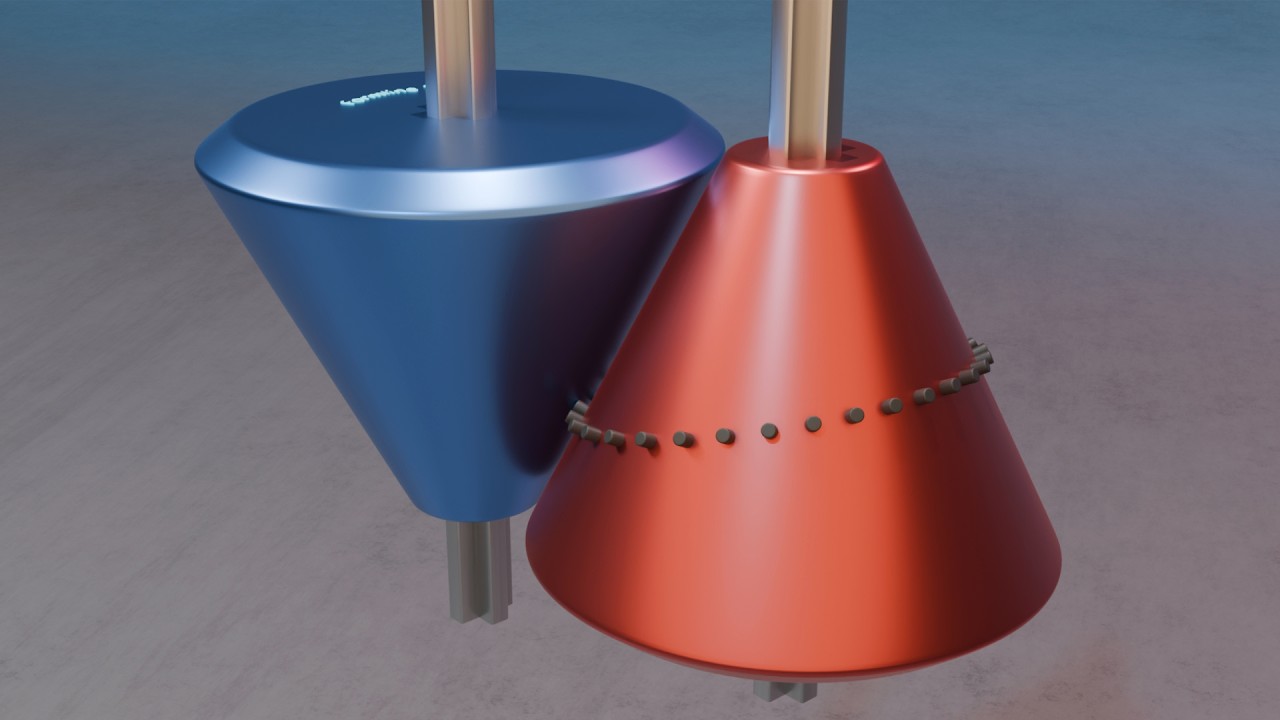
Movement No. 46 presents one of the most elegant and historically celebrated mechanisms in all of horology — the fusee chain and spring-box, the prime mover of fine English pocket watches and precision timepieces. The central engineering challenge this mechanism solves is deceptively subtle: a coiled mainspring does not deliver a constant torque throughout its unwinding. When freshly wound, the spring is tightly coiled and exerts its maximum force. As it uncoils over hours of running, the force it delivers decreases progressively — and in a simple watch without compensation, this means the timepiece runs faster when newly wound and slower as the spring winds down, introducing unacceptable timekeeping errors. The fusee is an ingenious conical pulley, shaped like a truncated cone or a spiral-stepped spool, with a helical groove cut along its surface to guide a fine chain. The chain connects the fusee to the cylindrical spring-box containing the mainspring. The key to the fusee’s function lies in its varying diameter: when the watch is freshly wound and the mainspring exerts its greatest force, the chain sits on the small-diameter end of the fusee — the short lever arm reduces the torque transmitted to the gear train, compensating for the spring’s excess strength. As the spring uncoils and weakens over time, the chain progressively migrates to the larger-diameter portion of the fusee — the increasing lever arm compensates for the spring’s diminishing force, maintaining a nearly constant torque output to the watch’s gear train throughout the entire running period. The result is a remarkably constant driving force delivered to the escapement and balance wheel, enabling the watch to keep precise time from the moment it is wound until the spring is nearly exhausted.

@
2 minute read
#045 Frictional Grooved Gearing – 507 Mechanical Movements 3D Animation

#045 Frictional Grooved Gearing – 507 Mechanical Movements 3D Animation

Saturday, Mar 21, 2026

Movement No. 45 presents a mechanism described by Henry T. Brown as a comparatively recent invention at the time of publication — frictional grooved gearing. This innovative transmission system bridges the conceptual gap between conventional smooth friction wheels (like those of Movement No. 32) and conventional toothed gears (like Movement No. 24), combining elements of both into a hybrid mechanism with unique advantages. Unlike ordinary friction wheels, which transmit power solely through the frictional force between two smooth cylindrical surfaces pressed against each other, frictional grooved gearing features interlocking grooves and ridges machined into the contact surfaces of both wheels. These grooves and ridges mesh together like shallow teeth, greatly increasing the surface area in contact and therefore dramatically increasing the total friction force available for power transmission — without requiring the wheels to be pressed together with extremely high forces. The grooved profile also provides a degree of positive engagement beyond pure friction: the interlocking geometry of the grooves physically prevents the wheels from slipping relative to each other in the same way that flat friction surfaces would under high load. At the same time, unlike rigid gear teeth which can break under overload, the grooved friction surfaces can still slip and slip smoothly if the transmitted force exceeds the design limit, providing natural overload protection. The enlarged cross-section diagram included in the original illustration makes the interlocking groove geometry clearly visible, showing how the ridges of one wheel nest into the grooves of the other. This mechanism represents a thoughtful engineering hybrid — quieter and more overload-tolerant than toothed gears, yet more positive and higher-capacity than plain friction wheels.

@
2 minute read
#044 Stepped Spur Gear – 507 Mechanical Movements 3D Animation

#044 Stepped Spur Gear – 507 Mechanical Movements 3D Animation

Friday, Mar 20, 2026

Movement No. 44 presents a powerful and ingenious gear configuration designed specifically to transmit very large forces while maintaining continuous tooth contact — the stepped or staggered spur gear. In an ordinary spur gear, all teeth are cut in a single straight plane, and each tooth pair engages and disengages abruptly, creating load impulses and limiting the smoothness and load capacity of the transmission. Movement No. 44 addresses this fundamental limitation through an elegant structural solution: each gear wheel in the system is not a single spur gear, but rather a composite assembly of two, three, or more identical spur gears stacked side by side on the same shaft — with each successive layer rotated by a small angular step relative to the previous one, so that the teeth are not aligned in a straight line but arranged in a staircase or stepped pattern around the gear face. This staggered tooth arrangement ensures that as the gears rotate, the teeth of each successive layer engage the mating gear at slightly different moments — creating a continuous, overlapping sequence of tooth engagements rather than simultaneous impacts. At any given instant, teeth from multiple layers are in contact simultaneously, distributing the total transmitted force across many contact points and dramatically increasing the effective load capacity and smoothness of the drive. Henry T. Brown specifically highlights two major historical applications: driving screw propellers on ships — where enormous torque must be transmitted smoothly — and driving the beds of large iron-planing machines with a matching stepped rack, where smooth, powerful, and precise linear motion of heavy workpieces is essential. The stepped gear is a direct mechanical precursor to the modern helical gear’s philosophy of progressive tooth engagement, but achieves this through discrete layered stages rather than a continuous helix.

@
2 minute read
#043 Oblique Shaft Bevel Gear – 507 Mechanical Movements 3D Animation

#043 Oblique Shaft Bevel Gear – 507 Mechanical Movements 3D Animation

Thursday, Mar 19, 2026

Movement No. 43 is the second of two mechanisms (Movements 42 and 43) presenting different gear solutions for transmitting rotary motion between two shafts arranged obliquely to one another — shafts that are neither parallel nor intersecting, but skewed relative to each other in three-dimensional space. While Movement No. 42 addressed this challenge using crossed helical gears, Movement No. 43 presents a bevel-type gear solution adapted for oblique shaft arrangements. Bevel gears in their standard form (Movement No. 25) are designed to transmit motion between intersecting shafts — typically at 90 degrees — where the axes of both shafts meet at a common point. The variant shown in No. 43 extends this concept to handle shafts that are oblique: the cone geometry of the gear pitch surfaces is adapted so that the gear pair can accommodate the angular relationship between the two non-intersecting, non-parallel shafts. This type of oblique bevel gear arrangement provides a more positive, higher-load tooth engagement compared to the point-contact nature of crossed helical gears, making it better suited for moderate-to-heavy load transmission between skew shafts. However, the geometric complexity of designing and manufacturing bevel gears for non-standard oblique shaft angles is considerably greater than for standard 90-degree bevel gears. Together, Movements 42 and 43 illustrate two fundamentally different engineering approaches to the same geometric challenge of skew-shaft power transmission — crossed helical gears offering geometric versatility at the cost of load capacity, and oblique bevel gears offering higher load capacity at the cost of geometric complexity.

@
2 minute read
#042 Crossed Helical Gears – 507 Mechanical Movements 3D Animation

#042 Crossed Helical Gears – 507 Mechanical Movements 3D Animation

Wednesday, Mar 18, 2026

Movement No. 42 is the first of two mechanisms (Movements 42 and 43) demonstrating different gear types capable of transmitting rotary motion between two shafts that are arranged obliquely to one another — that is, shafts that are neither parallel nor intersecting, but skewed in three-dimensional space. This geometric arrangement is known as a skew shaft configuration, and it presents a unique challenge to gear designers: the axes of the two shafts do not share a common plane, meaning conventional spur gears (which require parallel shafts) and bevel gears (which require intersecting shafts) cannot be used. Movement No. 42 addresses this challenge with crossed helical gears — also known as screw gears or skew gears. These are essentially two helical gears with helix angles chosen such that when mounted on their respective skew shafts, their helical tooth surfaces mesh smoothly at the crossing point. Unlike spur or bevel gears where teeth engage along a line, crossed helical gears make point contact between their tooth surfaces — the two curved helical tooth profiles touch at a single point at any given instant, and this contact point moves across the tooth surface as the gears rotate. This point contact nature means that crossed helical gears have a lower load capacity compared to line-contact gears of the same size, and they require good lubrication to manage the sliding friction at the contact point. However, they offer the significant advantage of being able to connect skew shafts at virtually any angle and any shaft offset distance — a geometric versatility that no other simple gear type can match. Crossed helical gears are widely used in low-to-moderate load applications such as speedometer drives, instrument mechanisms, and small machinery where non-parallel, non-intersecting shafts must be connected.

@
2 minute read
#041 Wide-Face Helical Gear – 507 Mechanical Movements 3D Animation

#041 Wide-Face Helical Gear – 507 Mechanical Movements 3D Animation

Tuesday, Mar 17, 2026

Movement No. 41 presents a wide-face single helical gear — the second of two helical gear examples in the 507 Mechanical Movements collection, following the narrower helical gear of Movement No. 40. Both share the same fundamental principle: the teeth are cut at an oblique angle — a helix angle — to the gear’s rotational axis, rather than straight across as in ordinary spur gears. As Henry T. Brown states, this oblique tooth geometry gives a more continuous bearing than ordinary spur gears. The key distinction of No. 41 is its significantly wider tooth face. In a single helical gear, the oblique teeth engage progressively across the face width — one edge of the tooth makes contact first, and the contact zone sweeps across the full width of the tooth as rotation continues. In a narrow helical gear (No. 40), this sweep is short and the improvement over straight spur gears, while real, is limited. In a wide-face helical gear (No. 41), the contact line sweeps across a much greater distance, meaning that for an even larger portion of each rotation, multiple tooth pairs are simultaneously sharing the load. This results in even smoother power transmission, greater load capacity, reduced vibration, and quieter operation compared to narrower helical gears. The wider face does, however, generate a proportionally larger axial thrust force along the shaft axis, requiring robust thrust bearings to be incorporated into the shaft support design. The wide-face helical gear represents the practical optimum of single helical gear design — maximizing the smoothness and load-sharing benefits of oblique tooth geometry while remaining manufacturable as a single continuous helical tooth form.

@
2 minute read
#040 Helical Spur Gear – Oblique Teeth for Smoother Drive – 507 Mechanical Movements

#040 Helical Spur Gear – Oblique Teeth for Smoother Drive – 507 Mechanical Movements

Monday, Mar 16, 2026

Movement No. 40 presents the helical spur gear — a direct and important evolution of the ordinary straight-toothed spur gear of Movement No. 24. While both types transmit rotary motion between parallel shafts, the helical gear achieves this with a fundamentally different and superior tooth geometry: instead of teeth cut parallel and straight across the face of the gear, helical gear teeth are cut at an oblique angle — a helix angle — to the gear’s axis of rotation. This seemingly small geometric change produces several profound engineering advantages. Most importantly, as Henry T. Brown notes, the oblique teeth give a more continuous bearing than ordinary spur gears. In a straight spur gear, each tooth pair engages and disengages abruptly along a line contact — the full tooth width comes into contact almost simultaneously, producing an impulse-like load and the characteristic noise associated with spur gears. In a helical gear, by contrast, each tooth begins engagement at one edge and gradually comes into full contact across its width in a progressive, rolling manner as the gears rotate. This gradual engagement means that at any given moment, multiple teeth are partially engaged simultaneously, distributing the load more evenly and smoothly. The result is dramatically quieter operation, higher load-carrying capacity for the same tooth size, and significantly reduced vibration — making helical gears the preferred choice in automotive transmissions, industrial gearboxes, and any application where quiet, smooth, high-power operation is required. The trade-off is that the oblique tooth geometry generates an axial thrust force along the shaft that must be accommodated by appropriate thrust bearings — a limitation that the double-helical (herringbone) gear of Movement No. 41 is specifically designed to eliminate.

@
2 minute read
#039 Sun and Planet Gear – Watt's Crank Substitute – 507 Mechanical Movements 3D Animation

#039 Sun and Planet Gear – Watt's Crank Substitute – 507 Mechanical Movements 3D Animation

Sunday, Mar 15, 2026

Movement No. 39 presents one of the most historically celebrated gear mechanisms in the entire history of engineering — the Sun-and-Planet gear system, invented and famously employed by James Watt as a substitute for the crank in his steam engines. The story behind this mechanism is as fascinating as the mechanism itself: when Watt sought to convert the reciprocating (back-and-forth) motion of his steam engine piston into continuous rotary motion, the obvious solution was a simple crank. However, the crank had been patented by another inventor, James Pickard, leaving Watt legally barred from using it. Rather than pay royalties, Watt — together with his business partner Matthew Boulton and engineer William Murdoch — devised this elegant alternative. The mechanism consists of two spur gears: the larger sun gear at the center, and the smaller planet gear which is connected to the sun gear’s shaft by a rigid arm that maintains a constant distance between the two gear centers. The planet gear meshes with the outside of the sun gear. As the connecting rod from the piston pushes and pulls the arm carrying the planet gear, the planet gear rolls around the outside of the stationary sun gear — and because the planet is constrained to orbit the sun, this orbital motion is converted into rotation of the output shaft. A notable kinematic property of this arrangement is that if both gears are of equal size, the output shaft rotates twice for every complete orbit of the planet gear — giving twice the rotational speed compared to a simple crank of the same stroke length. Watt’s Sun-and-Planet gear is a landmark example of how engineering constraints can inspire creative and superior solutions.

@
2 minute read
#038 Partial Uniform & Variable Speed Gear – 507 Mechanical Movements 3D Animation

#038 Partial Uniform & Variable Speed Gear – 507 Mechanical Movements 3D Animation

Saturday, Mar 14, 2026

Movement No. 38 presents a clever gear mechanism designed to produce a very specific and practically useful motion profile: an output rotation that is uniform (constant speed) during one portion of each revolution, and intentionally variable (changing speed) during another portion — all driven by a single constant-speed input. This type of motion profile is highly valuable in machinery where different phases of a machine’s cycle demand different speed characteristics. For example, a cutting tool may need to advance at a constant, controlled speed during the actual cutting stroke for quality and precision, then return quickly at a varying speed during the non-cutting return stroke to maximize productivity. The mechanism achieves this dual-phase motion profile through careful geometric design of the gear or cam profiles involved. During the uniform-speed phase, the effective gear ratio remains constant — meaning the driving and driven elements maintain a fixed relationship, producing steady output velocity. During the variable-speed phase, the effective gear ratio changes continuously, causing the output to accelerate or decelerate smoothly. This is typically achieved by using a combination of circular gear sections (for the uniform phase) and non-circular or eccentric gear sections (for the variable phase) on the same wheel, so that a single revolution of the driver produces both speed regimes in sequence. The result is a single mechanism capable of delivering two fundamentally different motion characteristics within each complete cycle — a hallmark of elegant and efficient mechanical design that was widely sought after in 19th-century industrial machinery.

@
2 minute read
#037 Bevel Pinion & Spiral Stud Wheel – Variable Rotary Motion – 507 Mechanical Movements

#037 Bevel Pinion & Spiral Stud Wheel – Variable Rotary Motion – 507 Mechanical Movements

Friday, Mar 13, 2026

Movement No. 37 presents an inventive and visually striking mechanism for converting uniform rotary motion into variable rotary motion — using a bevel pinion whose full-face teeth mesh with a spirally arranged series of studs mounted on a conical wheel. The driver is a bevel-cut pinion or small gear with teeth cut across the entire width of its face, giving it maximum engagement capacity. Rather than meshing with conventional gear teeth on the driven side, this pinion engages with a series of cylindrical studs or pins arranged in a spiral pattern across the surface of a large conical wheel. As the pinion rotates at a constant speed, it successively contacts each stud in the spiral sequence. Because the studs are arranged in a spiral — meaning they are positioned at continuously varying radial distances from the axis of the conical wheel — the effective lever arm through which each stud pushes the conical wheel changes progressively with each engagement. When the pinion contacts studs near the large-diameter end of the cone, the effective radius is large and the conical wheel turns slowly with high torque; when it contacts studs near the small-diameter end, the effective radius is small and the wheel turns more quickly with less torque. This produces a smoothly varying, cyclically changing output speed from a perfectly uniform input — an elegant alternative to elliptical gears for applications requiring periodic speed variation. The spiral arrangement of the studs ensures a smooth and continuous sequence of engagements throughout each revolution, avoiding the abrupt speed changes that would result from a non-spiral stud layout.

@
2 minute read

© 2026 Formline 3D Mechanisms

Powered by Formline 3D

Formline 3D

Formline 3D is a 3D animation channel exploring the form, structure, and design of the world around us.

From everyday objects to complex machines, we use Blender and real-time graphics to visualize how things are built, how they work, and how their shapes come together.

No talking heads. No stock footage. Just carefully crafted 3D animations that turn objects, technology, and ideas into clear visual stories.

If you love design, engineering, products, or simply understanding how things are made — you’re in the right place.