#063 Jumping Star Wheel – 507 Mechanical Movements 3D Animation

#063 Jumping Star Wheel – 507 Mechanical Movements 3D Animation

Saturday, Apr 11, 2026

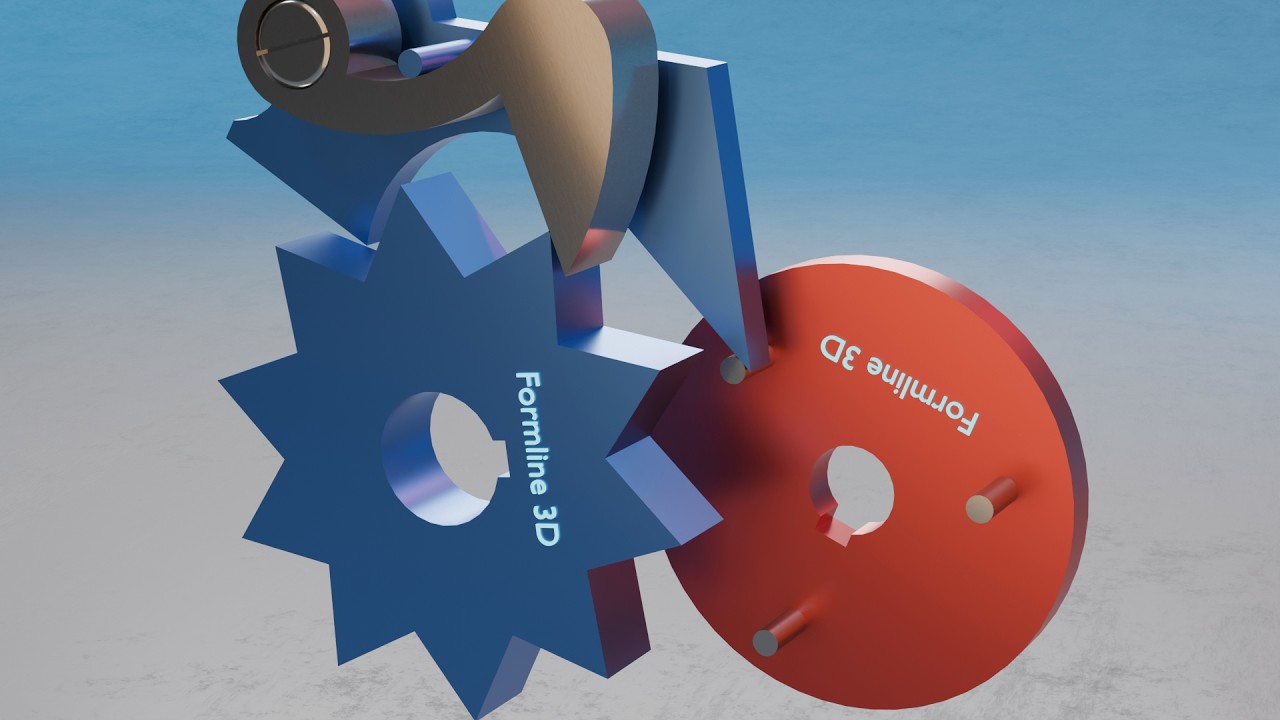
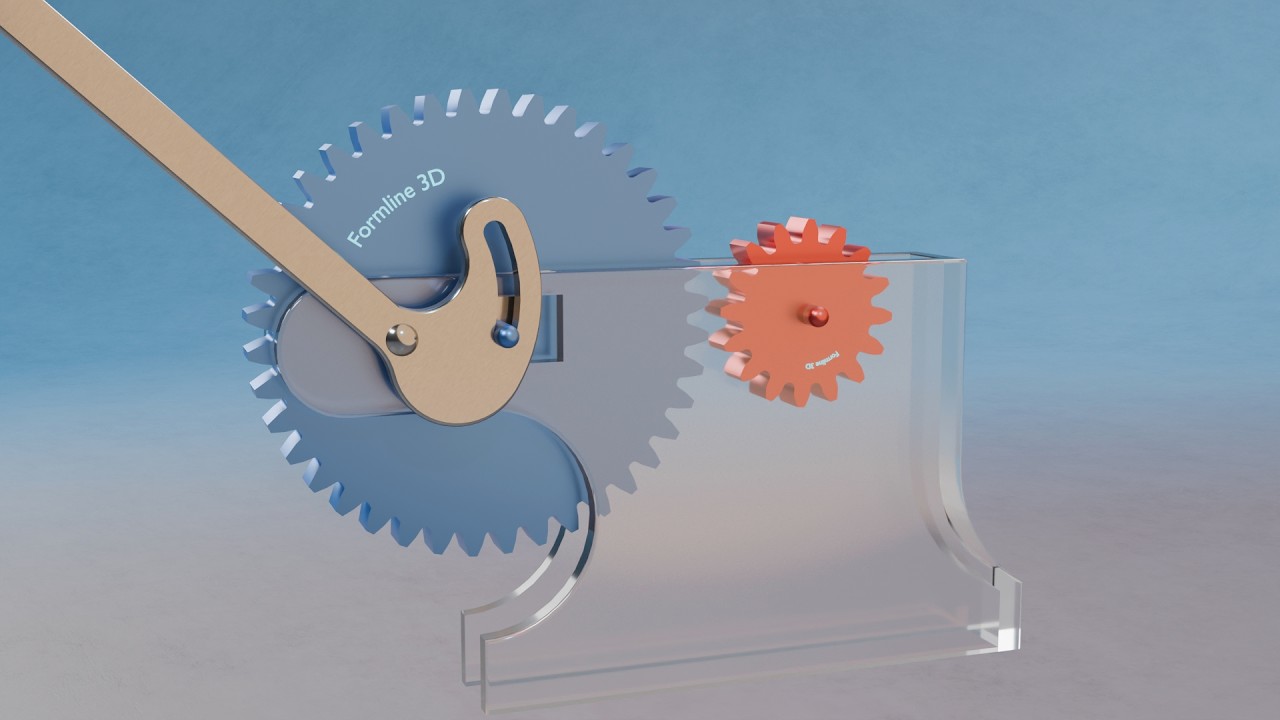
Movement No. 63 presents a beautifully precise intermittent motion mechanism — the jumping star wheel with drop pawl and spring — historically used in meters, revolution counters, and counting devices where a rapid, sharp, and exactly indexed rotary advance is needed once per input cycle. The mechanism has three key components working in sequence. First, a continuously rotating disk on the right carries a series of pins projecting from its face at regular intervals around its circumference. Second, a drop arm is mounted to the left, held up by a spring, with a pawl attached to it that rests in the spaces between the star-wheel’s points. Third, a star-wheel with evenly spaced pointed projections waits to be advanced. The sequence of operation is as follows: as the disk rotates, one of its pins lifts the drop arm — and with it, the attached pawl — upward against the spring force. As the pin continues rotating past the drop arm, the pawl is first released from the pin’s grip and drops into the next space of the star-wheel, positioning itself ready to push. The pin then continues to the drop arm’s catch point and releases it suddenly — the spring violently throws the drop arm downward. The drop arm carries a pin that strikes the pawl, which instantly delivers a sharp, rapid impulse to the star-wheel, advancing it one precise step. The star-wheel then stops and holds its position until the next disk pin repeats the cycle. This snap-action mechanism produces a crisp, well-defined, single-step advance of the star-wheel for each pin on the rotating disk — exactly the sharp, precise indexing needed for reliable digit counting in meters and mechanical counters.

@
2 minute read
#062 Variable Differential Speed Bevel Gear Drive – 507 Mechanical Movements 3D Animation

#062 Variable Differential Speed Bevel Gear Drive – 507 Mechanical Movements 3D Animation

Friday, Apr 10, 2026

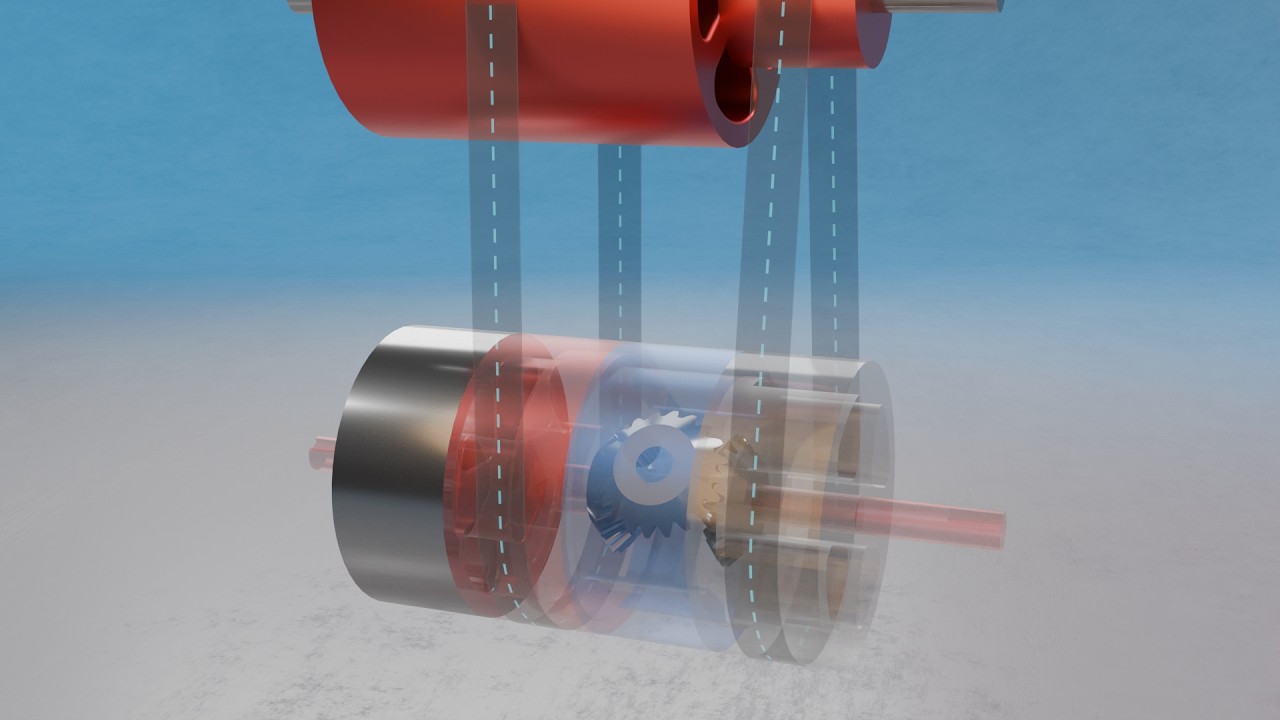
Movement No. 62 is a direct and more sophisticated extension of Movement No. 61, introducing the ability to continuously vary the output speed — not just select between two fixed speeds — by replacing the weighted friction-band on the third bevel gear with a fourth pulley actively driven by a separate belt from the upper shaft. The basic architecture is identical to No. 61: three pulleys on the lower shaft (one loose idler, one fast with a bevel gear on its hub, one loose with a transverse bevel gear), plus a third bevel gear interacting with the other two. The crucial difference is that in No. 62, this third bevel gear is now physically attached to a fourth pulley positioned to the right of the other three. This fourth pulley is driven by a separate belt coming from a small pulley on the upper driving shaft — meaning the third bevel gear is no longer passive or friction-held, but actively driven at a controllable speed. The result is a true variable differential drive. When the main left-hand belt engages the middle bevel gear pulley, the differential bevel gear system is active. The output shaft speed now depends on the combination of the main drive and the actively controlled third bevel gear speed. If the fourth pulley’s belt is open (same direction), the third bevel gear’s rotation subtracts from the base double speed — slowing the output. If the fourth pulley’s belt is crossed (opposite direction), the third bevel gear’s rotation adds to the base double speed — increasing the output beyond the base double speed. By varying the speed of the fourth pulley’s drive, or by crossing versus opening its belt, the operator can continuously vary and fine-tune the output shaft speed across a range — making this one of the most sophisticated continuously variable transmission concepts in the entire 507 collection.

@
3 minute read
#061 Differential Speed Drive with Bevel Gears – 507 Mechanical Movements 3D Animation

#061 Differential Speed Drive with Bevel Gears – 507 Mechanical Movements 3D Animation

Thursday, Apr 9, 2026

Movement No. 61 presents one of the most mechanically sophisticated speed transmission systems in the 507 collection — a two-speed drive that combines belt drive, bevel gearing, and a friction-band braking element to produce both a simple direct speed and a double differential speed from the same input. Three pulleys are arranged on the lower shaft. The leftmost is a loose idler — neutral, transmitting nothing. The middle pulley is fast on the shaft and has a small bevel gear fixed to its hub. The rightmost pulley is also loose on the shaft but carries a transverse bevel gear on its side. A third bevel gear sits loose on the shaft and is held partially stationary by a weighted friction-band — a curb that allows it to slip slightly under sudden speed changes but otherwise holds it. When the belt is placed on the middle fast pulley, the shaft is driven directly and simply at the input belt speed — the bevel gears are not actively engaged in the drive path and the result is a straightforward single speed output. When the belt is shifted to the right-hand loose pulley, the transverse bevel gear on that pulley meshes with the small bevel gear on the fast middle pulley’s hub and also with the third friction-held bevel gear. Because the third bevel gear is held nearly stationary by the friction curb, the rotation of the right pulley’s bevel gear is forced to react against it — and through the differential bevel gear action, the shaft is driven at double the speed compared to the simple mode. The weighted friction-band on the third bevel gear acts as a smooth shock absorber, allowing gradual engagement and preventing sudden mechanical shock when the speed is changed.

@
2 minute read
#060 Two-Speed Double Belt Drive – 507 Mechanical Movements 3D Animation

#060 Two-Speed Double Belt Drive – 507 Mechanical Movements 3D Animation

Wednesday, Apr 8, 2026

Movement No. 60 presents an elegant two-speed transmission system that uses two drive belts and a carefully arranged set of four pulleys to select between two distinct output speeds on the lower shaft — without any gears, clutches, or complex mechanisms. The lower output shaft carries four pulleys mounted side by side. The two outer pulleys are loose — they spin freely on the shaft and transmit no motion to it. The two inner pulleys are fast — they are keyed or fixed to the shaft and rotate with it as a rigid unit. Two drive belts connect the upper driving shaft to the lower output shaft — each belt running over one upper pulley and one of the lower four. The upper pulleys are of different diameters, giving each belt a different speed ratio when engaged. The speed selection works by shifting both belts simultaneously. In the first state — slow speed — the right-hand belt rides on its fast (inner) lower pulley, driving the shaft, while the left-hand belt rides on its loose (outer) lower pulley, freewheeling without driving. Only the right belt is actively transmitting, and the pulley-size ratio it engages produces the slower output speed. To switch to fast speed, both belts are shifted simultaneously: the right belt moves to its loose outer pulley (disengaging), and the left belt moves to its fast inner pulley (engaging). Now the left belt drives the shaft through a different pulley ratio, producing the faster output speed. This two-belt, four-pulley arrangement cleverly ensures that exactly one belt is always driving while the other freewheels — providing a seamless, continuous speed selection without interrupting the drive. The mechanism is a direct application of the fast-and-loose pulley principle that was fundamental to 19th-century mill and factory line-shaft systems.

@
2 minute read
#059 Two-Speed Belt and Gear Transmission – 507 Mechanical Movements 3D Animation

#059 Two-Speed Belt and Gear Transmission – 507 Mechanical Movements 3D Animation

Tuesday, Apr 7, 2026

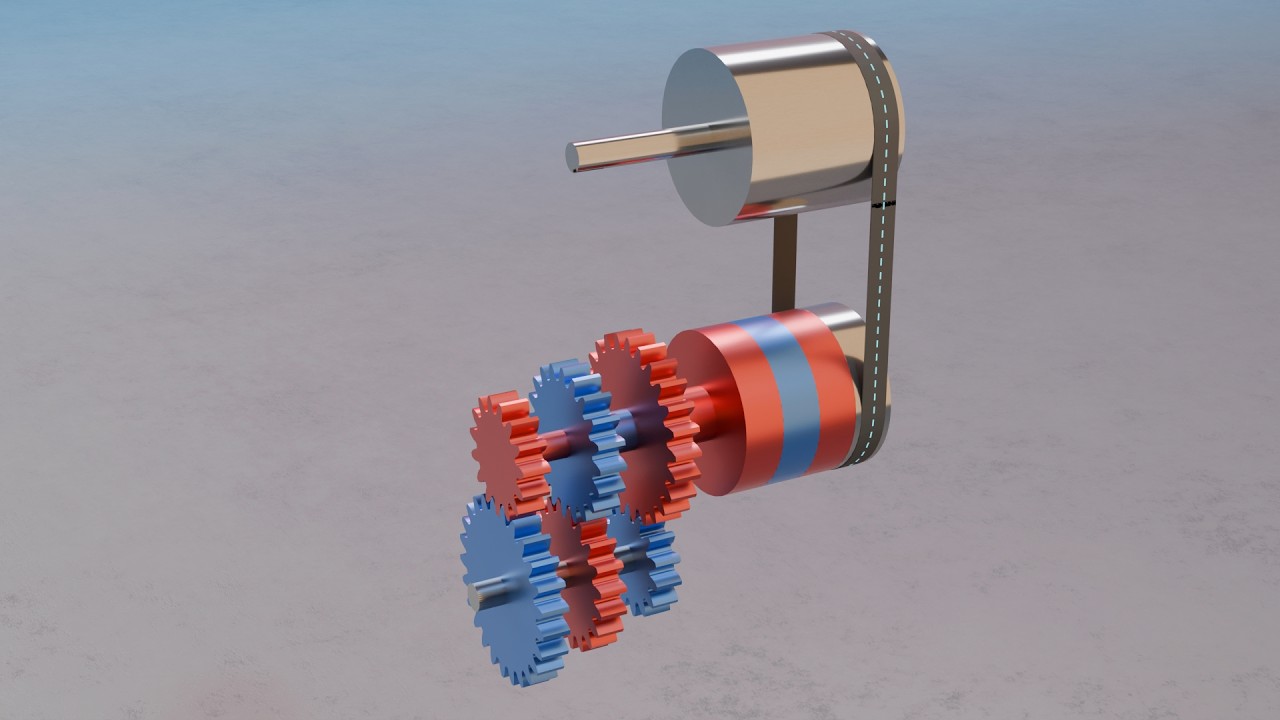
Movement No. 59 presents a compact and practical two-speed gear transmission system that uses a combination of belt drive and spur gearing to deliver two selectable output speeds to a lower shaft — plus a neutral disengaged state — by shifting a single drive belt across three pulleys. The three pulleys are arranged side by side on the input side. The leftmost pulley is a loose idler — when the belt rides here, no power is transmitted to any gear, placing the system in neutral. The middle pulley is fixed directly to the shaft of a small pinion gear. When the belt is placed on this middle pulley, the small pinion is driven and meshes with the output gear on the lower shaft — because the pinion is small relative to the output gear, this produces a slow output speed with high torque, as the large gear ratio reduces the speed significantly. The rightmost pulley is fixed to a hollow shaft that runs concentrically around the pinion shaft — independently of it — with a large spur gear fixed to its far end. When the belt is shifted to this rightmost pulley, the hollow shaft and its large spur gear are driven instead. Since the large spur gear is bigger than the small pinion, it meshes with the output gear at a more favorable ratio, producing a faster output speed proportional to the diameter difference between the two input gears. This elegant two-speed arrangement — neutral, slow, and fast — is directly related to Movement No. 58’s three-speed system, but simplified to two active speeds using one solid shaft and one hollow shaft, making it ideal for simpler machine tools and light industrial equipment requiring basic two-speed operation.

@
2 minute read
#058 Three-Speed Concentric Shaft Gear Transmission – 507 Mechanical Movements 3D Animation

#058 Three-Speed Concentric Shaft Gear Transmission – 507 Mechanical Movements 3D Animation

Monday, Apr 6, 2026

Movement No. 58 presents a highly ingenious multi-speed transmission system that delivers three distinct output speeds to a lower shaft using a clever arrangement of concentric hollow shafts, multiple pulleys, and spur gears of different sizes — all selectable by shifting a single drive belt. The input side consists of four pulleys mounted side by side. The first is a loose idler pulley — when the belt rides here, no motion is transmitted at all, giving a neutral state. The second pulley is fixed directly to the solid main shaft, which carries a small spur gear on its opposite end. The third pulley is fixed to a hollow shaft that runs concentrically over the main shaft — independent of it — and carries a second, larger spur gear on its other end. The fourth pulley is fixed to yet another hollow shaft that runs concentrically over the previous hollow shaft, also independent, carrying an even larger spur gear at its other end. All three spur gears of different sizes mesh with a common gear on the lower output shaft. When the belt is placed on pulley two, the main shaft and its small spur gear are driven — producing the highest output speed on the lower shaft due to the small gear ratio. When shifted to pulley three, the first hollow shaft and its medium spur gear are driven — producing an intermediate output speed. When shifted to pulley four, the outer hollow shaft and its large spur gear are driven — producing the lowest output speed with the highest torque. This elegant system of nested concentric shafts allows three completely independent speed ratios to be selected by a single belt shift, without requiring any gear-shifting mechanism — a remarkable feat of compact mechanical design used in machine tools and early industrial equipment.

@
2 minute read
#057 Belt-Driven Concentric Gears with Planetary Pinion – 507 Mechanical Movements 3D Animation

#057 Belt-Driven Concentric Gears with Planetary Pinion – 507 Mechanical Movements 3D Animation

Sunday, Apr 5, 2026

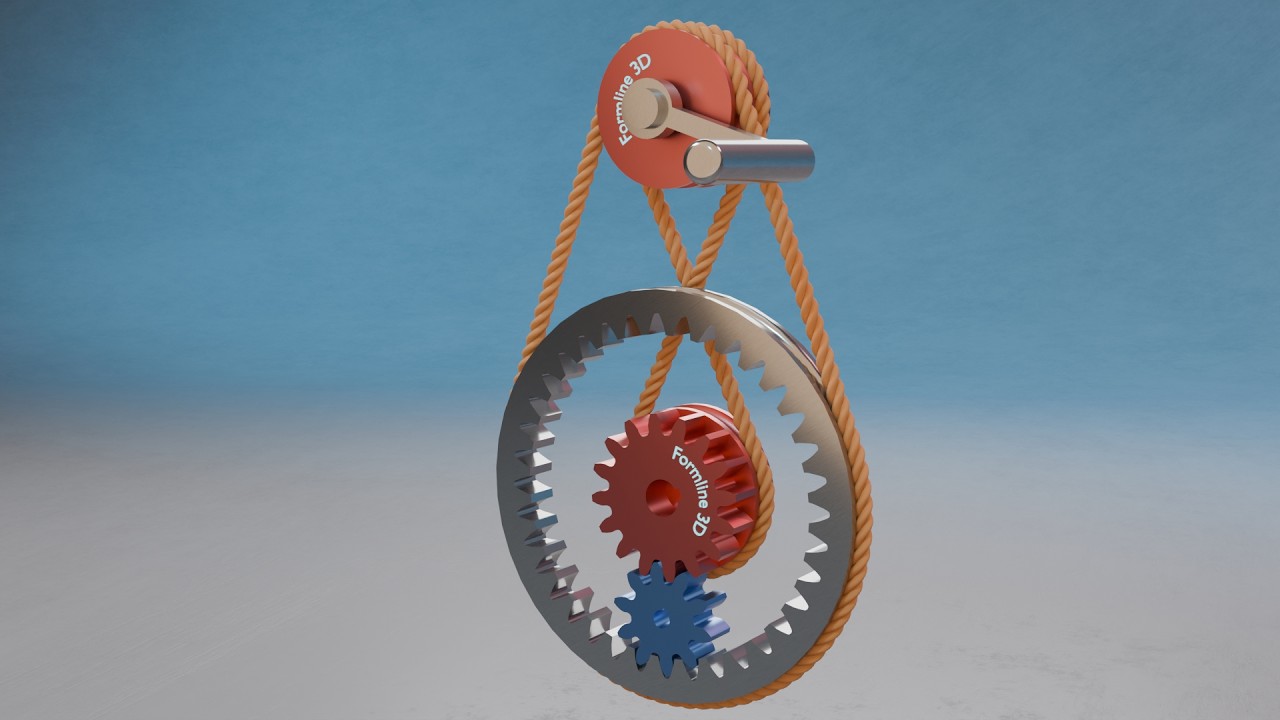
Movement No. 57 presents one of the most mechanically complex and visually spectacular mechanisms in the early sections of the 507 collection — a belt-driven system of two concentric gears driving an intermediate planetary pinion in a compound orbital motion. The driver is a small pulley at the top, which sends drive to the system via two belts or bands. These bands connect to the large internally-toothed ring gear and to a smaller concentric spur gear positioned inside it — both centered on the same axis. Crucially, the two bands are arranged so that the ring gear and the inner concentric gear are driven in opposite directions simultaneously — one clockwise and the other counterclockwise — by the single driving pulley. Between these two counter-rotating concentric gears sits an intermediate pinion at the bottom, meshing with both the inner surface of the ring gear and the outer surface of the inner concentric gear simultaneously. Because the two gears surrounding this pinion rotate in opposite directions, the pinion is driven to rotate about its own center axis — spinning on its own. But because the pinion is constrained between the two concentric gears and both are rotating, the pinion also undergoes orbital motion — revolving around the common center of the two concentric gears. The result is a compound planetary motion: the pinion simultaneously spins on its own axis and orbits around the central axis — a motion with characteristics directly related to early epicyclic and planetary gear theory. This combination of belt drive, internal gearing, and planetary motion makes Movement No. 57 one of the most intellectually rich mechanisms in the entire collection.

@
2 minute read
#056 Eccentric Slot Lever Back Gear – 507 Mechanical Movements 3D Animation

#056 Eccentric Slot Lever Back Gear – 507 Mechanical Movements 3D Animation

Saturday, Apr 4, 2026

Movement No. 56 presents a clever and compact mechanism used specifically for engaging and disengaging the back gear on lathes — a device that allows the lathe operator to select between high-speed direct drive and low-speed high-torque back-gear drive without dismantling anything. The mechanism works through the ingenious use of an eccentrically cut slot in a lever. The large wheel’s shaft does not run in a fixed bearing — instead, it slides within a slot that is cut into the lever arm. The critical geometric detail is that this slot is cut eccentrically relative to the lever’s pivot point or fulcrum: the slot’s centerline does not pass through the fulcrum, but is offset from it. When the lever is in its raised position, the eccentric slot geometry positions the large wheel’s shaft forward — bringing the large wheel into mesh with its mating gear and engaging the back gear drive. When the operator depresses the lever downward, the eccentric slot — being offset from the fulcrum — causes the shaft to be drawn backward as the lever rotates about its pivot. This backward movement of the shaft pulls the large wheel away from its mating gear, disengaging the back gear entirely. The elegance of this design lies in the fact that a simple lever depression simultaneously moves the shaft backward through the cam-like action of the eccentric slot, combining the functions of a cam mechanism and a lever into a single compact component. This mechanism was an essential feature of 19th-century metal-cutting lathes, enabling operators to quickly switch between high spindle speeds for light finishing cuts and low spindle speeds with high torque for heavy roughing cuts on large-diameter workpieces.

@
2 minute read
#055 Differential Speed Gears on Same Shaft – 507 Mechanical Movements 3D Animation

#055 Differential Speed Gears on Same Shaft – 507 Mechanical Movements 3D Animation

Friday, Apr 3, 2026

Movement No. 55 presents a deceptively simple yet conceptually rich gear arrangement: a single pinion B simultaneously driving two gears, A and C, which are mounted on the same shaft — but rotating at different speeds relative to each other. At first glance, this seems paradoxical — how can two gears on the same shaft rotate at different speeds? The answer lies in the fact that gears A and C are of different diameters and different tooth counts, while both mesh with the same driving pinion B. Because the speed ratio between a gear and its driving pinion is determined by the ratio of their tooth counts, gear A — having a different number of teeth from gear C — will be driven at a different angular velocity than gear C, even though the same pinion B drives both simultaneously. For this to work, gears A and C must be mounted loosely on the shared shaft — free to rotate independently — rather than being keyed to it. The shaft itself may then be driven by one of the gears through a selective clutch or other mechanism, or the arrangement may serve as the basis for a differential or compound gear train. This mechanism elegantly demonstrates that two gears can coexist on the same shaft axis while rotating at entirely different speeds, and that a single pinion can serve as the simultaneous driver for multiple gears of different ratios. This principle is fundamental to the design of compound gear trains, back-gear mechanisms in lathes, and multi-speed transmission stages found throughout mechanical engineering.

@
2 minute read
#054 Mangle Star Wheel – 507 Mechanical Movements 3D Animation

#054 Mangle Star Wheel – 507 Mechanical Movements 3D Animation

Wednesday, Apr 1, 2026

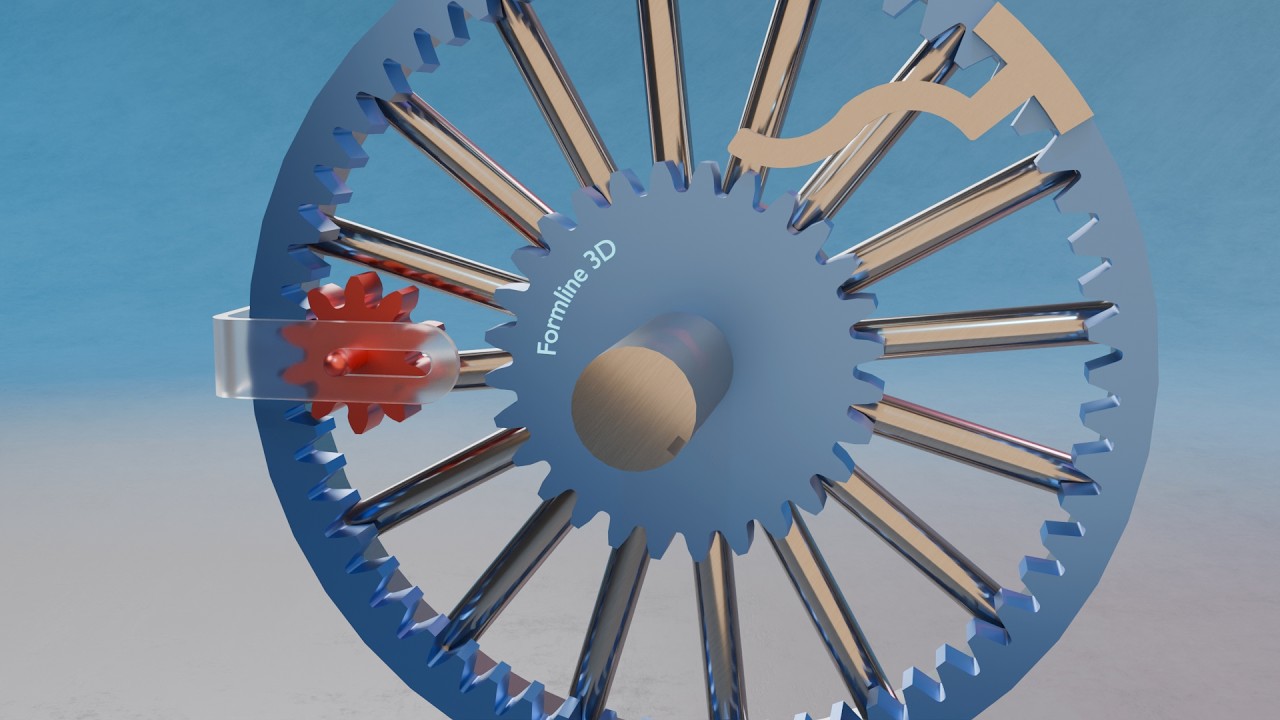
Movement No. 54 presents the Mangle Wheel in its star-wheel form — a mechanism designed to produce alternating rotary motion from a continuous unidirectional input. While Movement No. 36 introduced the classic mangle wheel with a pinion traveling inside and outside a continuous tooth track, Movement No. 54 presents a related but distinct variation: the star wheel configuration. The star wheel is a gear wheel with teeth or projections arranged around its periphery in a star-like pattern, combined with a driving element that engages these projections in sequence. The key characteristic shared with the mangle wheel family is the ability to produce reciprocating — back-and-forth — rotary output from a continuously rotating input, without requiring the input to reverse its direction. As the driving element rotates continuously in one direction, it engages the star wheel’s projections alternately on one side then the other, pushing the star wheel first in one rotational direction, then reversing it — creating the characteristic alternating rotary motion. This type of mechanism was historically used in mangle machines for pressing and wringing laundry, where the rollers needed to reverse direction periodically to feed the fabric back and forth. The alternating output is also useful in winding mechanisms, textile machinery, and any application where a periodic reversal of rotational direction is required from a continuously running prime mover. The star wheel’s simple, robust geometry makes it well suited for transmitting significant force while producing this alternating motion reliably and repeatedly.

@
2 minute read
Next page

© 2026 Formline 3D Mechanisms

Powered by Formline 3D

Formline 3D

Formline 3D is a 3D animation channel exploring the form, structure, and design of the world around us.

From everyday objects to complex machines, we use Blender and real-time graphics to visualize how things are built, how they work, and how their shapes come together.

No talking heads. No stock footage. Just carefully crafted 3D animations that turn objects, technology, and ideas into clear visual stories.

If you love design, engineering, products, or simply understanding how things are made — you’re in the right place.